
New Delhi: The Ministry of Power has notified new Corporate Average Fuel Economy (CAFE) norms for passenger vehicles. The norms will tighten the fuel-consumption benchmark every year for five years, starting April 1, 2027. The benchmark falls from 3.996 litres per 100 km in 2027-28 to 3.3273 litres per 100 km in 2031-32. The ministry said this represents "an improvement of around 16.7 percent over the period."
Follow Energy Watch on X
The norms apply to new passenger vehicles manufactured or imported for sale in India. They replace the existing CAFE norms and will remain in force until March 31, 2032. In a statement on Wednesday, the ministry said the framework "will drive progressive improvements in fuel economy through year-on-year tightening of targets across all five years." It also set out why the segment matters: "The passenger vehicle segment accounts for a substantial share of India's transport energy demand and remains an important contributor to fossil-fuel consumption."
Each carmaker's target depends on the average weight of the vehicles it sells. The gazette notification sets out a formula for this. The benchmark applies to a fleet at a reference weight, and the target moves up or down from there according to how much heavier or lighter a manufacturer's fleet is. The reference weight rises to 1,229 kg under the new norms, from 1,082 kg under the existing ones. The ministry said the increase of around 13.6 percent reflects "the evolving characteristics of the passenger vehicle fleet."
The benchmark tightens every year. It is 3.996 litres per 100 km in 2027-28, then 3.86 litres in 2028-29 and 3.7585 litres in 2029-30. It drops to 3.5313 litres in 2030-31 before reaching 3.3273 litres in the final year. The ministry has also changed how steeply the target moves with weight. "The revised target line has also been flattened to provide a more balanced, weight sensitive approach, with relatively softer targets for lighter vehicles and greater fuel efficiency requirements for heavier vehicles," it said.
The Society of Indian Automobile Manufacturers (SIAM) welcomed the norms. Its president, Shenu Agarwal, called them "CAFÉ III" and said: "CAFÉ III regulation lays down a structured roadmap with aggressive annual targets for next 5-years for the Auto industry along with a market-based compliance mechanism." He said the norms would cut fuel consumption from new passenger vehicles and "also provide an opportunity to the industry to work on various technology pathways providing multiple choices to the consumers."
Agarwal said the framework gives carmakers certainty. "The CAFÉ III regulation framework provides clear predictability which will enable the Auto industry to plan investments and accelerate innovation, thereby, playing an important role in the country's journey towards Viksit Bharat in 2047," he said. The ministry said the norms were "finalised following extensive consultations with automobile manufacturers, industry associations, academia and other stakeholders."
Cleaner vehicles will count for more than one unit in a manufacturer's fleet average. The ministry calls these volume derogation factors, or "super credits". Under the gazette notification, each battery electric vehicle (BEV) or range-extended electric vehicle (REEV) counts as three vehicles. Plug-in hybrid electric vehicles (PHEVs) and flex-fuel strong hybrids count as 2.5 vehicles each. A strong hybrid electric vehicle (SHEV) counts as 1.6, and a flex-fuel ethanol vehicle as 1.1. The ministry said this "provides an additional incentive for manufacturers to accelerate the deployment and market penetration of cleaner and advanced vehicle technologies."
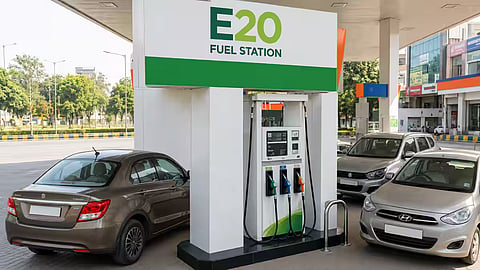
The norms also give credit for cleaner fuels through a new Carbon Neutrality Factor (CNF). This discounts a vehicle's declared tailpipe carbon dioxide emissions. Vehicles that run on E20 or higher ethanol-blended petrol, including strong and plug-in hybrids, get an 8 percent discount. Flex-fuel ethanol vehicles get 22.3 percent. Compressed natural gas (CNG) vehicles get 5 percent, or the compressed biogas (CBG) blending percentage notified by the petroleum ministry, whichever is higher. For diesel vehicles, the discount will follow the actual biofuel blending percentage. According to the ministry, the CNF "provides manufacturers with an additional pathway for improving their fleet-level CAFE performance, alongside vehicle efficiency improvements and electrification."
The ministry said the list of recognised fuel-saving technologies has grown "from four to twelve technologies". Some deal with the engine and drivetrain: start-stop systems, regenerative braking, transmissions with six or more speeds, efficient 12V/48V alternators and 12V/48V motor-generators. Others cut the load on the engine: electric water pumps, radiator fans whose speed is controlled electronically, exterior LED lighting and high-efficiency air-conditioning. The list also includes tyre pressure monitoring, advanced glazing and solar-reflective paint.
A manufacturer can claim 1 g of carbon dioxide per km for each eligible technology, up to a cap of 9 g per km. In the first compliance block, the energy savings claimed for these technologies will be based on self-declaration by manufacturers. In the second block, claims must be backed by validated test results under procedures to be set by the Ministry of Road Transport and Highways (MoRTH).
Manufacturers do not have to comply year by year. They may meet their obligations over compliance blocks: the first covers three years from 2027-28, and the second covers two years from 2030-31. A carmaker that beats its target earns credits, which it can carry forward within a block. Any credits left unused at the end of a block lapse.
A carmaker that falls short has three options. It can use credits it has carried forward, trade credits with another manufacturer, or buy credits from the Bureau of Energy Efficiency (BEE). The gazette notification sets the buyout price at Rs 2,500 per g of carbon dioxide per km in 2027-28, rising by Rs 500 each year to Rs 4,500 in 2031-32. All trading and buyouts must happen within a 30-day window, from October 1 to October 31 of each assessment year. The ministry said these provisions "are intended to ease the compliance burden, provide flexibility during the transition and enable manufacturers to manage variations in their product portfolio and technology adoption pathways."
Manufacturers must report fuel consumption under both the Modified Indian Driving Cycle (MIDC) and the Worldwide Harmonized Light Vehicles Test Procedure (WLTP). "This dual approach will facilitate India's gradual transition towards globally harmonised vehicle testing practices," the ministry said. It will separately notify a factor for converting the targets from MIDC to WLTP. Manufacturers will also have to submit state-wise sales data every year.
Follow Energy Watch on LinkedIN
Manufacturers selling fewer than 1,000 vehicles a year are exempt from the fleet-average targets, but they must continue to report their fuel consumption to BEE. MoRTH will enforce the provisions on testing, reporting, super credits and the carbon neutrality factor.

