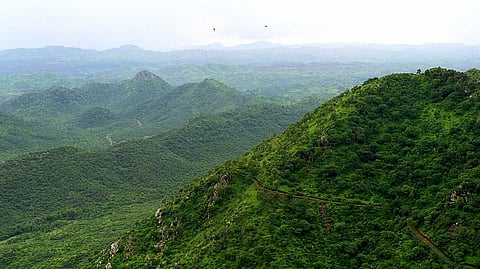

New Delhi: The Supreme Court (SC) on December 29 stayed the implementation of its own November 20, 2025 judgment that had accepted a uniform definition of the Aravalli Hills and Ranges and laid down a framework for regulating mining in the ecologically sensitive region.
Follow Energy Watch on X
In a strongly-worded order, the court said that both the expert committee’s report and its earlier judgment had “omitted to expressly clarify certain critical issues,” raising the risk of misinterpretation and flawed implementation.
The bench noted that there has been a “significant outcry among environmentalists” and “profound concern about the potential for misinterpretation and improper implementation of the newly adopted definition,” making it necessary for the court to intervene before irreversible damage is caused.
Questioning the core of the new definition, the court said it must be examined whether restricting the Aravalli Range to hills located within 500 metres of each other “creates a structural paradox wherein the geographical scope of protected territory is significantly narrowed.”
The bench also flagged the possibility that this approach may have “inversely broadened the scope of ‘non-Aravalli’ areas, thereby facilitating the continuation of unregulated mining and other disruptive activities” in landscapes that are ecologically connected to the Aravallis but technically excluded by the definition.
Taking note of criticism surrounding the elevation criterion, the court said it must be verified whether claims that only a fraction of Aravalli hills meet the 100-metre threshold — potentially stripping thousands of hillocks of protection — are “factually and scientifically accurate.”
If such concerns are found valid, the bench said it would be necessary to consider “an exhaustive scientific and geological investigation” involving precise measurement of hill and hillock elevations to ensure the “structural and ecological integrity of the entire range” is preserved.
The court said that before implementing the committee report or its earlier directions, “a fair, impartial, independent expert opinion must be obtained and considered, after associating all requisite stakeholders.”
Accordingly, it proposed constituting a high-powered expert committee to conduct a “comprehensive, exhaustive and holistic examination” of the definition, including whether even regulated or “sustainable” mining in newly demarcated Aravalli areas could result in adverse ecological consequences.
In the interim, the Supreme Court ordered that the committee’s recommendations and its November judgment be “kept in abeyance” to ensure that “no irreversible administrative or ecological actions are taken based on the current framework.”
As a matter of “abundant caution,” the bench reiterated that until further orders, no permission shall be granted for new or renewed mining leases in the Aravalli Hills and Ranges as defined in the Forest Survey of India’s (FSI) 2010 report, without prior approval of the court.
Follow Energy Watch on LinkedIN
The matter will now be heard by the green bench on January 21, 2026, with the Centre and the governments of Delhi, Rajasthan, Haryana and Gujarat directed to respond as the court re-examines the legal and scientific foundations of Aravalli protection.

