
New Delhi: The Ministry of Mines has notified the Minerals (Other than Atomic and Hydro Carbons Energy Minerals) Concession (Third Amendment) Rules, 2026 on April 10, 2026, introducing a methodology for publishing the average sale price (ASP) of haematite iron ore below the threshold value, including Banded Haematite Quartzite (BHQ) and Banded Haematite Jasper (BHJ).
Follow Energy Watch on X
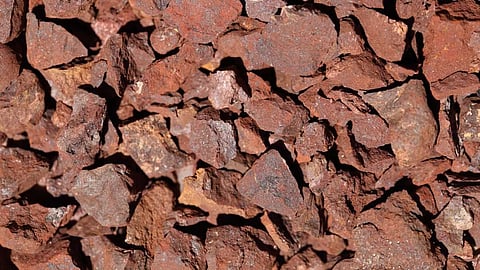
The ministry said the threshold value for haematitic iron ore is 45 percent Fe (minimum), and noted that there are “huge quantities” of iron ore below this level in the country, some of it in the form of BHQ and BHJ, which are the principal host rocks of iron ore.
According to the statement, improvements in processing and beneficiation technology have made these below-threshold resources amenable to beneficiation, allowing them to be converted into high-grade iron ore for steel-making. The ministry said a suitable policy framework was needed to support the beneficiation of such low-grade ore.
Before this amendment, there was no methodology to publish ASP for haematite iron ore with Fe content below the threshold value, including BHQ and BHJ. In practice, the ASP for the lowest grade above the threshold, that is 45 percent to below 51 percent Fe, was being used for these grades as well.
The ministry said this made beneficiation uneconomical because royalty, auction premium and other charges were being levied on lower-grade ore using the ASP of higher-grade material.
Under the amended rules, the ASP of haematite iron ore below threshold value will now be calculated in two slabs. For ore with 35 percent to below 45 percent Fe, the ASP will be 75 percent of the average sale price of 45 percent to below 51 percent Fe iron ore. For ore with below 35 percent Fe, the ASP will be 50 percent of the average sale price of 45 percent to below 51 percent Fe iron ore.
The ministry said the change will bring low-grade resources into the usable category, help address depletion of high-grade iron ore resources and ensure a steady supply to the steel industry. It added that use of low-grade ore will be in the interest of mineral conservation and will promote scientific and optimal mining. The ministry said the country will remain self-sufficient in iron ore.
The amendment also clarifies that where processing of run-of-mine results in a decrease in economic value, royalty will be chargeable on the lumps and fines after initial screening of unprocessed run-of-mine.
Follow Energy Watch on LinkedIN
The statement defined run-of-mine as raw, unprocessed or uncrushed material in its natural state obtained after blasting or digging from the mineralised zone of a lease area. It said raw minerals are required to be processed to increase concentration, remove impurities and make them usable for the industry.
The ministry said the rule change clarifies that the economic value of a mineral cannot be lowered in the name of processing run-of-mine.

