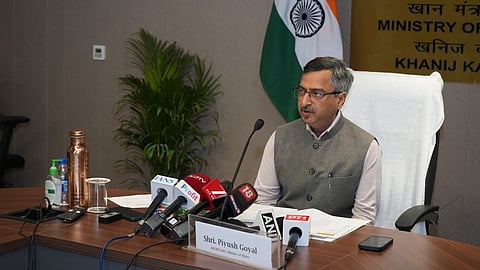


New Delhi: The government is in “advanced stages” of planning a scheme for processing of critical minerals, said Mines Secretary Piyush Goyal. During a media interaction on April 10, the Secretary said, “We are in advanced stages of formulating a scheme to develop processing value chains for critical minerals.” He added that due to the absence of processing facilities within the country, the government is unable to import Lithium from overseas.
Follow Energy Watch on X
Without getting into details, the official said that the scheme will focus on two critical minerals which are key to the electric vehicle (EV) value chain. “More details will be shared when it is approved,” said Goyal.
The Mines Secretary also said that state-run copper miner, Hindustan Copper Limited (HCL), was initially supposed to bid for one block in Chile but would now be bidding for four. “HCL was initially planning to take over one block in Chile. Then we assessed our that requirement of copper is large, and the availability is less, so, it was decided that HCL should bid for four blocks in collaboration with other PSUs,” said Goyal.
HCL is bidding jointly for these blocks along with NTPC Mining and Coal India Limited (CIL). Goyal informed the media that the agreement for taking over these blocks from CODELCO is in “final stages.” The Secretary exuded confidence that India will become a net exporter of Copper by the next year.
Commenting on India’s efforts to acquire critical mineral blocks abroad, Goyal said that the country is looking at critical mineral blocks in Canada. In addition, India is also exploring investment opportunities in Lithium assets in Argentina, Australia and Brazil. India had acquired its first-ever Lithium project by acquiring rights to explore and develop five Lithium brine blocks in Argentina’s Catamarca province through KABIL. Goyal said that production from these five mines is expected to begin in 2029.
India has identified 30 critical minerals essential for its high-tech industrial growth, electric vehicle (EV) transition, and defence needs, including Lithium, Cobalt, Nickel, Graphite, and Rare Earth Elements (REEs). They are indispensable for solar panels, wind turbines, batteries, electric vehicles, semiconductors, defence equipment, and medical devices.
Follow Energy Watch on LinkedIN
India is almost entirely import‑dependent for Lithium, Cobalt, and Nickel (around 100 percent in FY24), and heavily reliant on China‑dominated processing chains for REEs and other critical inputs. Therefore, it is following a strategy of a mix of domestic capability‑building, plus diversified international partnerships.
