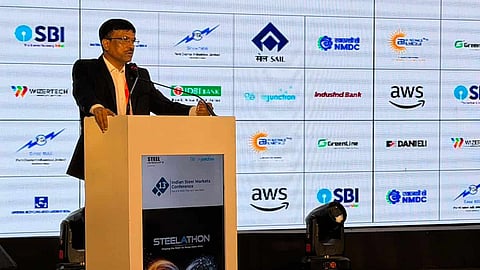


New Delhi: The use of scrap as a raw material in India's steel industry is set to grow phenomenally as iron ore, the mainstay of domestic steelmaking, loses its cost advantage, Steel Authority of India Limited (SAIL) Chairman AK Panda said on Wednesday. Delivering the inaugural address at the 13th Indian Steel Markets Conference — STEELATHON: Shaping the Scrap-to-Steel Value Chain, Panda said scrap would shift from being treated as waste to a valued input.
Follow Energy Watch on X
"Going forward, scrap will become a raw material. It is not just waste. It is wealth. And the use of scrap in India's steel industry is going to grow phenomenally," Panda said. He linked the shift to the changing economics of iron ore, which underpins almost all of India's current output.
"Ninety-nine percent of our production is through BOF [Basic Oxygen Furnace] route because the use of raw metal here is iron ore and iron ore is 'supposedly' cheap. I say 'supposedly' because it was cheap but it is not cheap going forward because of the imposition of so many taxes and royalty structures from the state governments," Panda said.
Panda said the anticipated growth in scrap use would come through the Electric Arc Furnace (EAF) route, though a complete switch was not yet viable. "But when we talk about scrap, which is, of course, one of the major components of the future, where there is a huge growth waiting. It will be happening through EAF route. But can we afford it now? At this point of time, for 100 percent of the quantity (of steel produced), no," he said.
He set out the case for the transition resting on decarbonisation and the rising availability of scrap as economies expand.
"But nonetheless, going forward, this EAF growth is going to be very important, primarily because of two or three reasons. One is, of course, decarbonisation. The other one is, we are mining more and more, whether it is India, China or Russia, or even South African countries. But a time will come when there will be more availability of scrap in the market. And this scrap, which is there because of the growth in the economy, which is a by-product of the economy, will require recycling," Panda said.
Panda framed steel as central to the wider economy and to its recovery after the pandemic. "Steel is the backbone of any economy. It may be contributing to around 7-8 percent of the total economy, but it gives a trigger. After the COVID-19 pandemic, when the economy had to kickstart, it was the steel sector which came forward," he said.
He said consumption was climbing sharply in developing economies even as it turned negative in mature markets.
"Going forward, we know that the steel consumption is increasing and it is increasing at a very high rate in developing countries like India. So, in India steel production is going at a rate of around 7-8 percent per annum. Even in developed countries, like China, the US etc, it has become negative. But there is a lot of scope in countries like us where per capita steel consumption is low and it is going to increase going forward," Panda said.
He added that the country was working towards a target of producing 300 MT of steel by 2030.
Delivering the keynote address, Tata Steel Vice President Ashish Anupam drew a parallel between India's current trajectory and China's earlier growth phase, while flagging the emissions challenge now facing the sector.
"Between 2000-2010, China rode the wave of economic growth propelled by infrastructure growth which translated into steel production growth. India is in the same situation right now. What is different between the journeys of the two countries is that China did not see the issue of carbon emission. Those days it was not the hot topic. Today it is," Anupam said.
He said the steel industry was squarely in the frame on emissions. "And why is it an issue for the steel industry? Because we account for 7-8 percent of carbon emissions," he said.
Anupam pointed to the contradiction at the heart of the energy transition. "Now here is the paradox. In order for the world and the country to be carbon-free, you would need renewable power, you would need e-mobility, you would need green infrastructure, and to build all this, you need to make steel," he said.
Follow Energy Watch on LinkedIN
He cautioned that no single technology would resolve it. "There is no one answer to solve the problem. We talk of carbon capture and utilisation, we talked of Electric Arc Furnace, but there is no one single bullet which will solve the problem," Anupam said.
