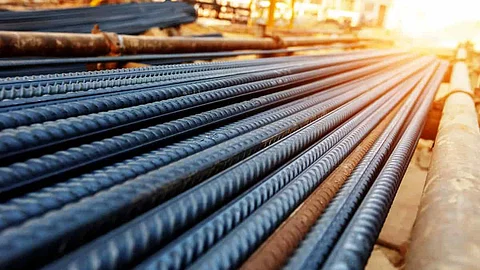

New Delhi: The European Union’s (EU) carbon tax on select metals will come into force from Thursday and is expected to hurt India’s steel exports, the Global Trade Research Initiative (GTRI) said on Wednesday. The 27-nation bloc is imposing the levy on goods that emit carbon during the manufacturing process.
Follow Energy Watch on X
In steel, emissions are highest under the Blast Furnace–Basic Oxygen Furnace (BF–BOF) route, lower for gas-based Direct Reduced Iron (DRI), and lowest for scrap-based Electric Arc Furnace (EAF) routes. In aluminium, the electricity source and power intensity are critical. Power generated from coal significantly raises the carbon burden and, in turn, the Carbon Border Adjustment Mechanism (CBAM) cost.
GTRI said many Indian exporters may be forced to cut prices by 15–22 percent so EU importers can use that margin to pay the CBAM tax. Indian exporters will not pay the tax directly, as EU-based importers — registered as authorised CBAM declarants — are required to buy CBAM certificates linked to the embedded emissions in imported goods. However, this cost will be pushed back to Indian exporters, it said.
“From 1 January 2026, every shipment of Indian steel and aluminium entering the EU will carry a carbon cost as the Carbon Border Adjustment Mechanism (CBAM) moves from reporting to payment phase,” GTRI Founder Ajay Srivastava said.
He said the CBAM’s complex data and verification requirements will sharply raise compliance costs, potentially pushing many smaller exporters out of the EU market altogether.
Accurate emissions measurement, he added, will become the foundation of competitiveness in the EU market.
“CBAM is not a corporate sustainability exercise; it is a plant-level emissions accounting regime. Emissions must be calculated for each installation, covering direct fuel combustion and electricity consumption,” Srivastava said.
Manufacturing exporters, he explained, will have to track fuel use, electricity consumption, production volumes and emission factors on a quarterly basis.
“Records must be auditable and aligned with EU methodologies. Without this discipline, exporters face default emission values set by the EU — intentionally conservative and often 30–80 per cent higher than actual emissions,” he said.
From 2026, independent verification of emissions data will become mandatory, with only EU-recognised or ISO 14065-compliant verifiers accepted. The process will resemble a financial audit involving document review, emissions validation and formal certification.
Srivastava said low-emission producers using cleaner electricity could find that CBAM becomes a competitive advantage in the EU market. “Verified low emissions can protect margins and help win market share as higher-emission suppliers lose ground,” he said.
He suggested that Indian exporters develop an internal CBAM shadow price by calculating embedded emissions per tonne and applying the EU carbon price to it.
Follow Energy Watch on LinkedIN
India’s steel and aluminium exports to the EU fell 24.4 percent from USD 7.71 billion in FY24 to USD 5.82 billion in FY25.
The carbon tax remains a key issue in the ongoing negotiations for the proposed trade agreement between India and the European Union.

