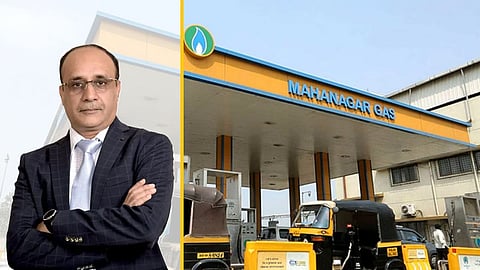


New Delhi: Meeting the government’s target of increasing the share of natural gas in India’s energy mix to 15 percent by 2030 would be a “very challenging” task unless issues of affordability and procurement-side price volatility are addressed, said Mahanagar Gas Limited’s (MGL) Managing Director Ashu Shinghal in an interview with Energy Watch.
Follow Energy Watch on X
He emphasised that bringing natural gas under the Goods and Services Tax (GST) regime would be crucial to making the fuel more competitive against alternatives.
The government first announced the 15 percent target in 2018, when natural gas accounted for 5.8 percent of India’s energy basket. More than six years later, the share stands at around 6–6.7 percent. While gas consumption has grown in absolute terms, overall energy demand has also increased significantly, limiting the rise in gas’s share.
Against this backdrop, Shinghal outlined the structural constraints facing the sector — from price volatility and taxation to competition from renewables and electric mobility — and explained where he sees realistic growth emerging.
Here are edited excerpts:
With MGL and other players focused on gas, where do you see growth coming from within the gas sector, particularly in the context of India’s plan to raise gas’s share in the primary energy basket?
We are expecting that growth will be coming from the CGD industry. Overall, the share of gas is around 6 percent in the primary energy basket, which is targeted to go to 15 percent by 2030. So CGD will be playing an important part.
Right now, CGD is the second-largest consumer of gas. It is expected to become number one in the next few years, bypassing the fertilizer industry.
However, on the procurement side, there is a lot of volatility that we need to address. Affordability is another issue. Infrastructure is largely in place — gas terminals and connectivity are there — but if we address affordability on the customer side and volatility in gas prices on the procurement side, growth can happen very fast.
To take demand to a level where we can increase the share of gas to 15 percent in the energy mix, what needs to be done?
If you look sector by sector — in the power sector, a lot of renewable energy is available at cheaper rates, so gas-based power is not clearing merit order dispatch. In the fertilizer sector, there is a limit. New fertilizer plants have come up, but the increase in gas supply is limited.
In other sectors, refineries will pick up. CGD has good potential. Right now, the CGD industry is consuming around 43–44 MMSCMD, and it is expected to reach up to 100 MMSCMD in the next few years — more than double.
Provided procurement stability is there. If Henry Hub and Brent prices are more stable, we can see growth happening.
Bringing gas under GST is another important issue. The PNGRB is supporting the sector — for example, through zone 1 tariff for the CGD industry — but GST inclusion will be critical for competitiveness.
Within the CGD industry, there is growing competition from other fuels and electric mobility. How do you see gas sustaining its position?
The bigger threat for the CGD industry is electric vehicles, at least in the small vehicle segment.
But in the heavier segment, gas is much cheaper compared to petrol and diesel. Diesel is more polluting. So CNG is expected to play an important part in the mid-commercial vehicle segment. In the heavy commercial vehicle segment, LNG can play an important role.
Why has LNG in long-haul mobility not picked up significantly?
There are a few reasons. One is that transporters are very distributed — there are not many large fleet owners. The whole ecosystem was not ready earlier.
The trucks are available. Logistics was an issue earlier, but that is being addressed. More LNG retail outlets are coming up.
Pricing has also been an issue. Earlier, nobody was offering pricing indexed to diesel. Now, some are offering around a 10 percent discount on LNG compared to diesel prices.
Some of these issues are getting addressed, and then it will pick up. LNG trucks are slightly costlier than diesel trucks, so there is pushback. But if the low-carbon footprint agenda is promoted, we will get a better outcome.
Do you think the 15 percent target is achievable by 2030, given we are already in 2026?
In physical numbers, we have increased gas production and consumption. But overall energy consumption in India is growing. Therefore, the share of gas is still around 6 percent despite higher consumption.
Bringing it from 6 percent to 15 percent by 2030 is very challenging. Unless we take further steps to promote gas in different sectors and ensure that the carbon footprint advantage is reflected in pricing benefits.
There has been a decline in APM gas allocation. How has it affected your margins?
For us, domestic gas allocation is around 35 percent of our total consumption. The decline in APM gas allocation is not just for us — it is for the whole industry.
Beyond 35 percent, we have to arrange gas on our own. However, whatever APM is being deallocated is being substituted with New Well Gas (NWG). So physically, we are not getting reduced quantities, but APM is coming down and prices are going slightly up, as NWG is pricier.
We purchase gas from a variety of sources — Brent-linked, HPHT, new well gas, APM and the exchange. Brent is low as of now. With operational efficiencies, margins are sometimes constant or better, depending on the market scenario.
The increasing proportion of NWG has not really impacted our costs much. We are able to manage the cost. It is not a very big impact.
Could you provide a breakup of gas consumption across your consumer base?
We have four segments. Almost 70 percent of gas goes to CNG, which is the transport sector. Around 16 percent goes to the domestic PNG segment. Another 16 percent goes to industrial and commercial segments.
Most of your geographical areas are in Maharashtra. Do you plan to expand outside the state?
It depends. It is a long-term process. As of now, we have six geographical areas — five in Maharashtra and one in Karnataka.
We are in discussions with some companies, but there is nothing to declare to the market as of now.
Is the market infrastructure mature enough to support faster growth in gas consumption?
Pipeline capacity for evacuating gas from terminals, terminal capacity itself, CNG infrastructure and automobile manufacturing — everything is in place.
So we should see some growth momentum going ahead.
