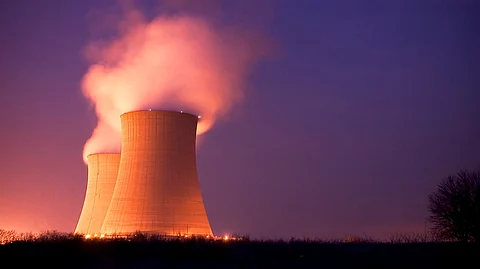


New Delhi: The Prime Minister Narendra Modi-led government has tabled the Sustainable Harnessing and Advancement of Nuclear Energy for Transforming India (SHANTI) Bill, 2025, in Parliament in the last week of the Winter Session on Monday, seeking to open India’s tightly controlled civil nuclear power sector to private participation for the first time in decades.
Follow Energy Watch on X
Approved by the Union Cabinet on December 12, the proposed legislation allows any company or joint venture to build, own, operate or decommission a nuclear power plant or reactor, marking one of the most significant shifts in India’s nuclear policy since Independence as the country targets 100 GW of nuclear power capacity by 2047.
Under the Bill, the operator of a nuclear installation will be liable for damages arising from a nuclear incident, except those caused by “a grave natural disaster of an exceptional character, an act of armed conflict, hostility, civil war, and insurrection or terrorism.”
The legislation, however, specifies that the operator will not be liable for damage to “under-construction nuclear installation itself and any other nuclear installation including a nuclear installation under construction, on the site where such installation is located, any property on the same site which is used or to be used in connection with any such installation; or the means of transport upon which the nuclear material involved was carried at the time of nuclear incident.”
“The maximum amount of liability in respect of each nuclear incident shall be the rupee equivalent of three hundred million Special Drawing Rights or such higher amount as the Central Government may specify by notification,” the Bill states.
While opening up large parts of the value chain, the proposed law draws clear boundaries for private participation. It states that “enrichment or isotopic separation of prescribed substance or radioactive substance, the management of spent fuel, including reprocessing, recycling, separation of radionuclides contained therein and management of high-level radioactive waste arising thereof, the production of heavy water and its upgradation by isotopic separation” will be undertaken exclusively by the government.
At the same time, the private sector will be permitted to participate in the fabrication of nuclear fuel, including conversion, refining and enrichment of uranium-235 up to a threshold value to be notified by the Central government. It may also undertake the production, use, processing or disposal of other prescribed substances, transport or store nuclear fuel or spent fuel, or handle any other prescribed substance.
The Bill allows “the import, export, acquisition, or possession of nuclear fuel or prescribed substance, the import or export of any technology or software, that may be used for the development, production or use of prescribed substance or prescribed equipment.”
However, it mandates that while setting up such facilities or undertaking permitted activities, all source material and fissile material, whether produced within India or imported, will remain under the surveillance and control of the Central government for accounting purposes and will be subject to safeguards specified by it.
The proposed legislation further provides that spent fuel must be delivered to the Central government for subsequent management or repatriated to the country of origin, and that heavy water used in any nuclear facility will remain under the supervision of the Central government.
The Bill notes that “it is desirable to harness the potential of nuclear energy through active involvement of both public and private sectors and to leverage the participation of the domestic industry to contribute to and benefit from the global nuclear energy ecosystem including research, technology, manufacturing, finance, insurance and skill development.”
The Cabinet approval follows the announcement made by Finance Minister Nirmala Sitharaman in her February Budget speech for 2025-26, where she outlined plans to open up the nuclear power sector to private players. Sitharaman had also announced a Nuclear Energy Mission focused on research and development of small modular reactors, with an outlay of Rs 20,000 crore, and a target to operationalise five indigenously developed SMRs by 2033.
Follow Energy Watch on LinkedIN
The SHANTI Bill, approved at a Cabinet meeting chaired by Prime Minister Narendra Modi, is expected to be tabled in Parliament shortly, setting the stage for a landmark overhaul of India’s civil nuclear framework.
