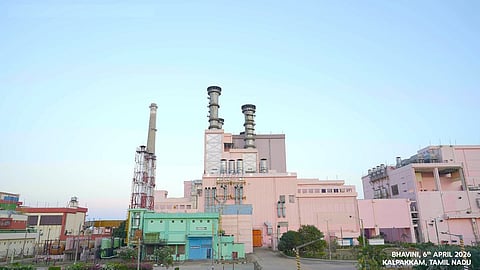

New Delhi: India’s 500 MWe Prototype Fast Breeder Reactor (PFBR) achieved first criticality on the night of April 6 at 8.25 pm, the Department of Atomic Energy said on Tuesday, describing it as a “landmark achievement” for the country’s nuclear energy programme. The statement said the milestone marks the start of a controlled fission chain reaction and is expected to strengthen long-term energy security while advancing indigenous nuclear technology capabilities.
Follow Energy Watch on X
Lauding the achievement, Prime Minister Narendra Modi said in a post on X on April 6, “Today, India takes a defining step in its civil nuclear journey, advancing the second stage of its nuclear programme. The indigenously designed and built Prototype Fast Breeder Reactor at Kalpakkam has attained criticality. This advanced reactor, capable of producing more fuel than it consumes, reflects the depth of our scientific capability and the strength of our engineering enterprise. It is a decisive step towards harnessing our vast thorium reserves in the third stage of the programme. A proud moment for India. Congratulations to our scientists and engineers.”
The criticality was achieved in the presence of Ajit Kumar Mohanty, Secretary, Department of Atomic Energy and Chairman, Atomic Energy Commission, Sreekumar G Pillai, Director, Indira Gandhi Centre for Atomic Research, Allu Ananth, CMD-In-Charge, Bharatiya Nabhikiya Vidyut Nigam Ltd, and KV Suresh Kumar, former CMD, Bharatiya Nabhikiya Vidyut Nigam Ltd and Homi Sethna Chair.
The department said the reactor reached the milestone after meeting all stipulations of the Atomic Energy Regulatory Board, which had issued clearance after a rigorous review of the safety of the plant systems.
The PFBR was designed by the Indira Gandhi Centre for Atomic Research, an R&D centre under the Department of Atomic Energy, and built and commissioned by Bharatiya Nabhikiya Vidyut Nigam Ltd, a PSU under the department.
According to the statement, the project reflects the effort of scientists, engineers, technicians and industry partners who contributed to the reactor’s design, fabrication and construction using predominantly indigenous technologies and components.
Fast breeder reactors are a cornerstone of India’s long-term nuclear strategy, the statement said. Unlike conventional thermal reactors, the PFBR uses Uranium-Plutonium Mixed Oxide fuel, with a core surrounded by a blanket of Uranium-238.
The department said fast neutrons convert fertile Uranium-238 into fissile Plutonium-239, allowing the reactor to produce more fuel than it consumes. It added that the reactor is designed to eventually use Thorium-232 in the blanket, which will be converted into Uranium-233 for the third stage of India’s nuclear power programme.
“With the achievement of first criticality, India moves closer to realising the full potential of its three-stage nuclear power programme,” the statement said.
The department said the milestone demonstrates the strength of India’s indigenous design, engineering and manufacturing ecosystem. It said the reactor incorporates advanced safety systems, high-temperature liquid sodium coolant technology and a closed fuel cycle approach that enables recycling of nuclear materials.
Follow Energy Watch on LinkedIN
The statement said the fast breeder programme will strengthen capabilities in nuclear fuel cycle technologies, advanced materials, reactor physics and large-scale engineering. It added that the reactor will help deliver “reliable, low-carbon, base-load power” with higher thermal efficiency as India expands its clean energy portfolio.
The department said the achievement is “a major step towards a sustainable and self-reliant energy future for Viksit Bharat.”

