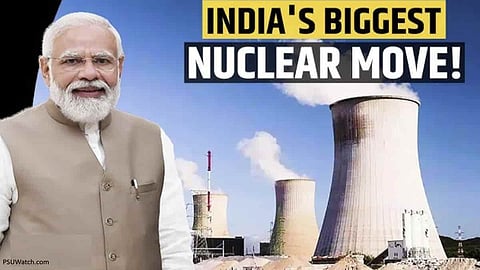

New Delhi: In a landmark move to bolster India's clean energy ambitions, both houses of Parliament have passed the Sustainable Harnessing and Advancement of Nuclear Energy for Transforming India (SHANTI) Bill, 2025, replacing outdated atomic laws and opening the civilian nuclear sector to regulated private participation.
The new law aims to overhaul India’s civil nuclear energy framework by replacing the Atomic Energy Act, 1962, and the Civil Liability for Nuclear Damage Act, 2010, and to open the nuclear power sector to limited private and foreign participation under regulatory oversight. Opposition parties and experts are mainly attacking it on grounds of safety, dilution of nuclear liability, scope for crony capitalism/privatisation in a strategic sector, weak regulation, and lack of broader consultation.
Follow Energy Watch on X
SHANTI stands for Sustainable Harnessing and Advancement of Nuclear Energy for Transforming India Bill, 2025. It seeks to modernise and consolidate India’s nuclear law to align with current and future energy needs, climate goals, and planned scale‑up of nuclear capacity (roadmap towards ~100 GW by 2047 is often cited in explanatory notes and analyses).
SHANTI repeals the Atomic Energy Act, 1962 and the Civil Liability for Nuclear Damage (CLND) Act, 2010, replacing them with a single unified framework for nuclear development, safety, and liability.
It gives statutory backing and stronger powers to the Atomic Energy Regulatory Board (AERB) and creates new institutions such as a Nuclear Damage Claims Commission for compensation in case of accidents.
Private and foreign participation
For the first time, it allows regulated entry of Indian private companies, joint ventures, and foreign partners into building, owning, operating, and decommissioning civilian nuclear power plants, ending the exclusive operational role of NPCIL in many segments.
Keeps sensitive fuel‑cycle activities (enrichment, reprocessing, strategic materials) under tighter government control, with the state retaining command over weapons‑related and strategic domains.
Liability and insurance regime
Replaces the CLND 2010 framework with a new civil liability regime in which the operator bears primary liability, capped according to plant capacity, backed by compulsory insurance (around Rs 1,500 crore per incident via the Indian Nuclear Insurance Pool, as described in exam/analysis notes).
Explicit supplier liability is removed or significantly diluted, which is central to both industry interest and opposition criticism.
Clean energy and technology focus
Positions nuclear as a low‑carbon baseload source crucial for energy security and India’s net‑zero‑by‑2070 commitments, in complement to renewables.
Aims to promote advanced reactors and Small Modular Reactors (SMRs), including for industrial decarbonisation and captive power.
Why is opposition creating uproar over SHANTI Bill?
Privatisation of a strategic sector
Opposition MPs of TMC, DMK, AAP, Left, SP and others in Lok Sabha and Rajya Sabha have called the Bill “dangerous” and a threat to peace, security, and sovereignty for opening nuclear power generation to private players and potentially foreign capital.
Opposition argues that it ends decades of exclusive government control over nuclear power, risks crony capitalism, and could prioritise private profit over public safety and long‑term strategic interests as it caps liability at upto Rs 1,500 crore.
Left and regional parties point to the removal/dilution of supplier liability and capping of operator liability as shifting risk from companies to citizens and taxpayers in case of a major accident.
Concerns include, lower effective deterrence for safety lapses, weaker bargaining power with foreign reactor vendors, and potential difficulty for victims to secure adequate, timely compensation despite the proposed Nuclear Damage Claims Commission.
Safety, regulation, and oversight
Opposition leaders and some experts argue that, even with statutory status, AERB may not be sufficiently independent or robust to regulate powerful private and foreign operators in a high‑risk domain.
Questions are raised about:
Capacity of regulators to enforce global‑standard safety norms across multiple private sites.
Long‑term waste management, decommissioning liabilities, and disaster‑management readiness in densely populated areas
Process and consultation
Several MPs had demanded that the Bill be sent to a Standing Committee or Joint Parliamentary Committee for detailed scrutiny, arguing that a complete overhaul of nuclear law and liability cannot be rushed.
They cite inadequate consultation with states hosting nuclear sites, local communities, and the wider scientific and legal community. However, the bill was passed in Rajya Sabha and through a voice vote amid loud protests by the Opposition in Lok Sabha on December 18.
Broader policy and energy‑mix critique
Choice of nuclear vs renewables
Some opposition voices question whether large‑scale nuclear is the optimal path for energy transition when solar, wind, and storage costs are falling.
They describe nuclear as expensive, long‑gestation, and high‑risk, arguing that public funds and regulatory bandwidth might be better focused on renewables, grid modernisation, and decentralised energy.
Security and proliferation anxieties
There is unease about opening parts of the nuclear value chain to private/foreign participants in a region with evolving security threats, raising fears of sabotage, cyber‑attacks, and insider risks.
Concerns persist that commercial pressures could, over time, erode tight controls around materials and information even if the Bill formally preserves state control over strategic fuel‑cycle steps.
Follow Energy Watch on LinkedIN
Proponents in government and strategic community argue that:
India cannot meet baseload and decarbonisation needs at required scale and reliability without a larger nuclear share and faster capacity addition.
Limited, tightly regulated private participation is needed to mobilise capital, accelerate project execution, absorb advanced designs (including SMRs), and reduce fiscal burden on the exchequer.
The new liability and regulatory framework is framed as “pragmatic” to attract technology and investment while still ensuring an operator‑centric responsibility and mandatory insurance for victims.

