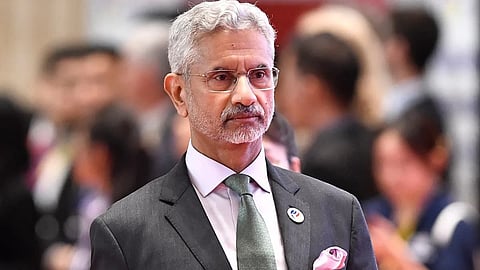

New Delhi: External Affairs Minister S Jaishankar said in Kyiv on September 3 that the war in Ukraine would not be resolved by whether or not countries buy Russian crude oil. He was responding to queries after talks with Ukrainian Foreign Minister Andrii Sybiha, and called on President Volodymyr Zelenskyy later the same day.
Follow Energy Watch on X
"This conflict, which is today in its fifth year, will not be solved because somebody is buying or not buying oil or alumina or minerals or metals or fertiliser. This conflict will be solved by dialogue, by diplomacy, by negotiation, and that is why it is something we would encourage," Jaishankar said.
He tied India's purchases to the scale of domestic demand. "I think it's also important that all of you get the challenges of providing for energy for 1.4 billion people at a time when the world energy situation is very, very difficult," he said. On the difference between the two positions, he said: "The Ukraine side has its perspective, which we respect, and we have ours, which I would expect others to also respect."
Russia remained India's largest crude supplier in August at about 2.1 million barrels per day (bpd), according to Kpler data. That was down from about 2.6 million bpd in June and July, but still accounted for more than 40 percent of India's total crude imports. Kpler attributed the fall to refinery maintenance, a normalisation after heavy buying in earlier months, lower Russian export availability and rising competition from China, rather than to any softening of Indian demand.
Attacks on commercial shipping featured in both engagements. In his statement after the meeting with Sybiha, Jaishankar said Indian seafarers crewed ships of many flags and had been among the casualties, and that the disruption was feeding fuel, fertilizer and food shortages across the Global South. Zelenskyy said the two had discussed the Black Sea, including threats to civilian shipping, and both sides agreed that blocking food supplies to sensitive regions was unacceptable.
The route carries a direct cost for buyers. Ukrainian drone strikes that widened into the Black Sea on July 17 hit 12 vessels, among them a Suezmax struck twice at anchor outside the Caspian Pipeline Consortium (CPC) terminal near Novorossiysk, according to an analysis by Kpler. Tanker rates on the Baltic Exchange's TD6 route rose from about Worldscale (WS) 230 in mid-June to around WS530, equivalent to roughly USD 400,000 a day, Seatrade Maritime reported, while Black Sea port-call war risk cover is estimated to have doubled since late July to as much as 2 percent of a ship's value.
"Our conversation centred on approaches to end the ongoing conflict," Jaishankar said in a post on X after calling on Zelenskyy. The Ukrainian President said: "We are grateful to India for its commitment to ending this unjust war – Russia's war against Ukraine."
In his earlier statement, Jaishankar said India was ready to help "in any manner" if the parties wanted it, and repeated India's position that solutions would not emerge from the battlefield.
He invoked Prime Minister Narendra Modi's remarks to Russian President Vladimir Putin in Bishkek on August 31, on the sidelines of the Shanghai Cooperation Organisation (SCO) summit. "Every day spent in war sets humanity back, whereas every step taken towards peace fills humanity with new hope and enthusiasm," Modi said at that meeting. "We must move away from endless war and an end to the war. This is essential for the well-being of humanity." Modi also said a peaceful resolution to all issues at the earliest was "the call of humanity, and this is India's message."
The remarks came with US legislation on Russian energy trade still in play. The Lindsey O Graham Russia Sanctions Act of 2026 passed the Senate on August 7 by 86 votes to 11 and awaits action in the House of Representatives. The bill authorises secondary tariffs of up to 100 percent on major importers of Russian oil and gas. India is not named in the text, though the analysis identifies it as a likely target and notes the list is set by the US Trade Representative on a rolling basis.
Follow Energy Watch on LinkedIN
On the bilateral track, Jaishankar said India had sent 19 consignments of humanitarian assistance to Ukraine, comprising 160 tonnes of generator sets, medicines and medical equipment, and that further assistance was under discussion. He invited Sybiha to India for the next meeting of the Intergovernmental Commission the two chair.

