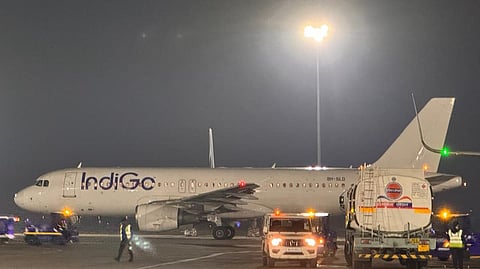


New Delhi: The Union Cabinet, chaired by Prime Minister Narendra Modi, on Wednesday approved a one-time budgetary support of up to Rs 10,000 crore for Oil Marketing Companies (OMCs) to stabilise Aviation Turbine Fuel (ATF) prices for Scheduled Indian Airlines on their domestic and international operations, as carriers and state-run fuel retailers grapple with a sharp spike in jet fuel prices triggered by the West Asia crisis.
Follow Energy Watch on X
The support will be extended as interest-free advances to OMCs through the Demands for Grants of the Ministry of Petroleum and Natural Gas, and is designed to compensate the fuel retailers for losses they incur whenever the prevailing Import Parity Price (IPP) of ATF exceeds a benchmark price to be fixed under the mechanism. The move effectively cushions state-run OMCs, like Indian Oil, Hindustan Petroleum Corporation Ltd (HPCL) and Bharat Petroleum Corporation Ltd (BPCL), which have been absorbing under-recoveries on jet fuel sold to domestic airlines at capped rates.
The decision addresses a squeeze that has been building for months. Domestic ATF has been held at Rs 1,04,927.18 per kilolitre since April, frozen for a second straight month, with OMCs estimated to be losing around Rs 30 a litre (or Rs 30,000 per kl) on jet fuel supplied to domestic carriers, a senior oil ministry official said earlier this week.
Jet fuel was deregulated more than two decades ago and is aligned with international benchmarks, but the war-driven surge would have warranted the steepest-ever increase, prompting the government to moderate domestic prices, while foreign carriers continue to pay market-linked rates. The Rs 10,000 crore corpus is the government's move to absorb part of that gap rather than leave it on OMC books.
ATF accounts for nearly 40 percent of an airline's operating costs in normal times and can climb to as much as 60 percent during periods of extreme volatility. International ATF prices surged from Rs 60.50 a litre in March 2026 to Rs 142 a litre in May 2026 — an increase of about 135 percent, or roughly 2.3 times. The government characterised the rise as "nearly 2.5 times."
The corpus will compensate OMCs for losses from elevated international ATF prices. To give carriers predictability, the scheme adopts a fixed-price arrangement for both domestic and international operations, reducing their exposure to sudden spikes. It will be available to all willing Scheduled Indian carriers.
Crucially, the support is a recoverable advance, not a grant. When international ATF prices moderate, the differential will be recovered from OMCs and returned to the Consolidated Fund of India, and the arrangement will continue until the entire amount is fully recovered and settled.
The arrangement will be implemented through a memorandum of understanding (MoU) between participating airlines and OMCs, with the Ministry of Civil Aviation and the Ministry of Petroleum and Natural Gas as signatories. Under the one-time arrangement, participating airlines will procure ATF exclusively from OMCs for up to three years, subject to annual review or until the advance is fully recovered, whichever is earlier.
Welcoming the decision, Minister of Civil Aviation Ram Mohan Naidu said, "Under the decisive leadership of Prime Minister Shri Narendra Modi, the Government has consistently taken timely and calibrated measures to safeguard the interests of passengers, airlines and the broader aviation ecosystem. Earlier, under the Emergency Credit Line Guarantee Scheme (ECLGS), nearly Rs 5,000 crore was earmarked for airlines, providing critical liquidity support. Today, the Cabinet has once again taken a far-reaching decision by approving Rs 10,000 crore of interest-free support to OMCs for ATF price stabilisation. This intervention will bring significant relief to airlines by reducing uncertainty in fuel costs and will ultimately benefit our passengers through reduced airfare."
Naidu said the decision builds on a series of measures already taken. "Since the onset of this unprecedented situation, the Government has adopted a proactive and multi-layered approach to support the aviation sector while safeguarding passenger interests. For domestic operations, the increase in ATF base prices was moderated and capped at 25 percent despite the much steeper rise witnessed in global fuel markets. In addition, landing and parking charges for domestic carriers were reduced by 25 percent. Also, I am thankful to the Chief Ministers of Delhi and Maharashtra for reducing VAT on ATF to 7 percent, from where nearly 75-80 percent of the country's ATF uplift takes place," he said.
Hailing the decision in a post on X, Petroleum Minister Hardeep Singh Puri said, "The fund will help stabilise ATF prices for scheduled Indian carriers and will prevent disruption of airline operations while protecting air passengers from fare spikes driven by the geopolitical conflict involving several energy producers. Even as the global supply chains have been severely impacted, several countries including those in South Asia and many in the west, India has successfully maintained steady and uninterrupted supply of affordable and sustainable energy. Our OMCs have only implemented very minor price adjustments as they continue to serve the energy consumers. For ATF also, India has not raised prices for domestic airlines despite very high international prices."
"This fund will protect 77 lakh jobs dependent on the aviation ecosystem and safeguard substantial public investment in airport infrastructure by keeping airline operations viable and will help maintain regional and international connectivity," he added.
The relief comes against the backdrop of the West Asia conflict's fallout on aviation. The Strait of Hormuz, a critical artery for global energy flows, has remained effectively closed as the war entered its fourth month, straining fuel supply. The closure of Pakistani airspace to Indian carriers has further lengthened flight paths to Europe, North America and Central Asia, raising fuel burn and operating costs, even as long-haul fares have risen substantially, international demand has declined, and airlines have reduced or suspended services on several international routes.
The ATF price stabilisation support will remain in force for 36 months, with provision for annual review, or until the advance is fully recovered and settled, whichever is earlier; it may be extended beyond that period with the approval of the competent authority if the corpus is not fully trued up. A Monitoring Committee comprising representatives of the Ministry of Civil Aviation, the Ministry of Petroleum and Natural Gas and the Department of Expenditure will oversee implementation, claim verification, reconciliation and settlement, with all claims and recoveries subject to audit.
Follow Energy Watch on LinkedIN
The government said the mechanism would shield OMCs from losses, sustain domestic and international connectivity, including to remote, regional, Tier-II and Tier-III cities and airports built under the UDAN scheme, and reduce the pass-through of fuel shocks to passengers. "The decision has been greatly appreciated by the aviation industry and beyond because of the huge cascading effect over other sectors like tourism, hospitality, trade and exports. With this we would be able to ensure continuity in air operations facilitating passengers as well as high value air cargo," Naidu said. He linked the move to the government's vision of Viksit Bharat 2047.
