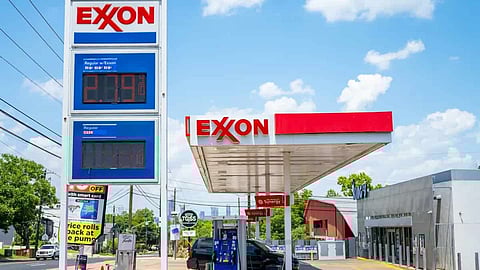

New Delhi: ExxonMobil on Tuesday said it has increased its 2030 plan for earnings and cash flow by USD 5 billion each, while projecting a sharp rise in upstream output to 5.5 million oil-equivalent barrels per day by 2030. Updating its Corporate Plan through 2030, the company said the transformation undertaken in recent years is now delivering improved financial outcomes.
Follow Energy Watch on X
“Several years ago, when we began to transform this company, we did so with one objective: to fully unlock our competitive advantages. Today, our transformation is driving industry-leading results,” ExxonMobil chairman and CEO Darren Woods said.
“With our updated Plan, we’re extending that leadership position. By 2030, we now expect USD 25 billion in earnings growth and USD 35 billion in cash flow growth vs. 2024 on the same constant price and margin basis,” he said. Woods added that the company expects to achieve this “with no increase in capital, while generating a return on capital employed of more than 17 percent.”
ExxonMobil said it expects cumulative surplus cash flow of roughly USD 145 billion through 2030 at USD 65 real Brent. The company remains on track to repurchase USD 20 billion of its shares this year, with plans to maintain that pace through 2026.
The company projected a significant rise in upstream production, saying total output is expected to reach 5.5 million oil-equivalent barrels per day by 2030. ExxonMobil now anticipates more than USD 14 billion in upstream earnings growth at constant prices versus 2024, an increase of USD 5 billion over prior guidance.
The expansion will be driven primarily by advantaged assets. By 2030, production from the Permian Basin, Guyana and LNG is expected to reach nearly 3.7 million oil-equivalent barrels per day, accounting for about 65 percent of total volumes.
In the Permian Basin, ExxonMobil said it has “the largest and highest-quality inventory position in the industry,” supported by proprietary technologies and integration benefits following the Pioneer acquisition. It expects to double production in the basin by 2030 compared to 2024, reaching approximately 2.5 million oil-equivalent barrels per day — about 200,000 barrels per day higher than its previous plan. Pioneer synergies are now estimated at USD 4 billion annually, double initial expectations.
Unit earnings excluding identified items, which ExxonMobil said have doubled since 2019, are projected to rise to more than USD 15 per barrel by 2030, three times 2019 levels.
The company said it has established the world’s first large-scale end-to-end carbon capture and storage system along the US Gulf Coast and has roughly 9 million tonnes of third-party CO₂ under contract annually. A final investment decision on its first integrated CCS-enabled low-carbon data centre project is targeted for late 2026.
Looking beyond 2030, ExxonMobil said new lower-emissions businesses — including Proxxima systems, carbon materials, CCS, hydrogen and lithium — have the potential to generate USD 13 billion in earnings by 2040. The company plans approximately USD 20 billion in lower-emission investments between 2025 and 2030, with about 60 percent aimed at reducing emissions for third-party customers.
Follow Energy Watch on LinkedIN
“As I’ve said many times, ExxonMobil is not defined by our products but by our capabilities,” Woods said. “Our transformation helps ensure that in any future market environment, and for decades to come, ExxonMobil will have an important role and deliver substantial shareholder value.”

