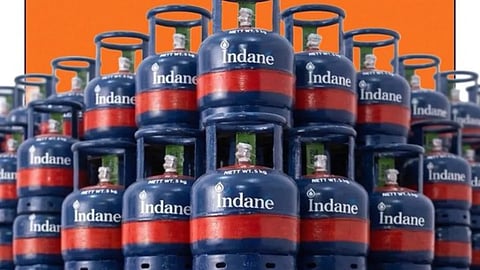

New Delhi: The government has doubled the daily quota of market-priced 5-kg LPG cylinders for migrant workers as part of efforts to stabilise fuel supplies amid disruptions linked to tensions around the Strait of Hormuz. At a briefing, Sujata Sharma, Joint Secretary, Ministry of Petroleum and Natural Gas, said the government “vide letter dated April 6 has conveyed that daily quantity of 5 kg free trade LPG (FTL) cylinders in each state available for disbursal to migrant labourers is being doubled based on the average daily supply (number of such cylinders) during March 2-3.”
Follow Energy Watch on X
She said sales have picked up in recent weeks. “Since March 23, about 7.8 lakh 5-kg FTL cylinders have been sold,” she said, adding that “on Monday more than 1.06 lakh 5-kg FTL cylinders were sold across the country.”
Unlike subsidised 14.2-kg domestic LPG cylinders used in households, the 5-kg cylinders are sold at market rates. In Delhi, a 5-kg cylinder is priced at Rs 549, compared to Rs 913 for a 14.2-kg cylinder. These smaller cylinders are available over the counter at LPG distributorships against a basic identity card, without requiring address proof, unlike regular domestic connections that require full KYC.
The move is aimed at migrant workers, many of whom do not have access to formal LPG connections.
With the West Asia conflict affecting energy supply chains, the government has prioritised LPG supply for households. Commercial users, who were initially restricted to 20 percent of their requirement, are now receiving up to 70 percent of pre-crisis allocation.
To support vulnerable groups, the government has increased the availability of 5-kg cylinders, which are more accessible to migrant labourers.
The government has stepped up enforcement to prevent hoarding and black marketing, conducting more than 4,300 raids across the country. Sharma urged consumers to avoid panic buying, stating that “adequate stocks are available and retail outlets are operating normally.”
Authorities said LPG and piped natural gas supplies are being prioritised for households and critical sectors such as hospitals. Refinery output has been increased, and alternative fuels are being promoted to manage demand.
Natural gas supplies to priority segments, including PNG for households and CNG for transport, remain fully protected, with additional allocations extended to fertiliser and industrial sectors.
Follow Energy Watch on LinkedIN
The government is also pushing expansion of city gas distribution networks to increase PNG coverage. Despite rising global crude prices, excise duties on petrol and diesel have been reduced to cushion consumers, while export levies have been imposed to ensure domestic availability.
Sharma said fuel supplies remain stable and called on states to counter misinformation through regular public communication.

