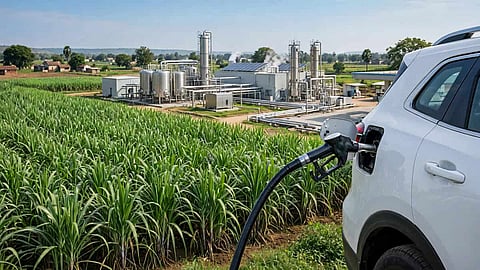

New Delhi: India should treat E20 as a long-term objective rather than a fixed floor, and let the blending rate fall temporarily to E15 in years when domestic ethanol runs short, a research paper from the Indian Council for Research on International Economic Relations (ICRIER) has said. The paper, titled Food vs Fuel: Recalibrating India's Ethanol Blending Strategy and co-authored by agricultural economist Ashok Gulati, argues that the decision between holding E20, importing ethanol and cutting the blend should turn on which carries the lowest economic cost under prevailing conditions.
Follow Energy Watch on X
"Such a mechanism would allow the programme to respond to temporary agricultural shocks without compromising the longer-term objective," the paper said.
It sets the blending rate itself as the last line of defence. "The final safeguard should be flexibility in the blending rate itself. The 20 percent target can remain the long-term objective, while a temporary reduction to E15 could be considered in years when domestic ethanol availability becomes insufficient, or the cost of maintaining E20 becomes disproportionately high in terms of food and/or feed prices," the paper noted.
The Ethanol Blended Petrol (EBP) Programme is meant to cut dependence on imported fossil fuels and lift the use of domestically produced renewable fuel, with ethanol drawn from sugarcane, maize and surplus rice. The E20 target sets petrol at up to 20 percent ethanol by volume, and India reached it in Ethanol Supply Year (ESY) 2025-26, five years ahead of the original schedule. The ESY runs from November to October.
Ethanol supplied to oil marketing companies (OMCs) climbed from 1.73 billion litres (173.03 crore litres) in 2019-20 to a projected 12 billion litres (1,200 crore litres) in 2025-26, a compound annual growth rate (CAGR) of about 38 percent across six years. Output of the crops that feed the programme grew far more slowly over the same stretch.
"During the same period, maize production grew at 11.4 percent CAGR, rice at 4.4 and sugarcane at 5.1 percent. This widening gap in growth of ethanol demand for blending and the supply of feedstock to meet that demand is creating a growing food-versus-fuel trade-off," the paper said.
The paper locates the strain in the sugar market. "The trade-off is already evident in the sugar market. Where low opening stocks and lower production have coincided with a 44 percent rise in modal retail sugar prices, from Rs 45 per kg in July to Rs 65 per kg by 29 August," it pointed out.
OMCs picked up 6.79 billion litres (679.04 crore litres) of ethanol in ESY 2023-24 and 10.33 billion litres (1,033.31 crore litres) in 2024-25. Procurement up to June 2026 stood at 7.05 billion litres (705.43 crore litres). The spending against those three figures came to about Rs 48,757 crore, Rs 73,996 crore and Rs 49,577 crore, each inclusive of goods and services tax (GST) and transportation.
What the paper asks for is a feedstock strategy able to hold E20 without pushing hard on food markets when agricultural supplies tighten. "Sugar-based ethanol can remain important when sugar supplies are abundant, but sugar diversion should be moderated when stocks become tight," it said.
Maize should take on a larger share of ethanol demand as its productivity and market supply improve, according to the paper. Rice from the Food Corporation of India (FCI) should remain largely a residual outlet for genuine surplus stocks, and its pricing should be raised to at least acquisition cost.
Follow Energy Watch on LinkedIN
On handling a shortage as it arrives, the paper wants sugar imports used as an immediate buffer. FCI rice should be confined largely to genuine surplus, priced closer to at least what it cost to acquire. Feedstock allocation should respond to agricultural conditions rather than sit fixed, and the programme should be more open to importing both feedstock and ethanol. Taken together, the paper said, these point towards a more adaptive EBP framework.

