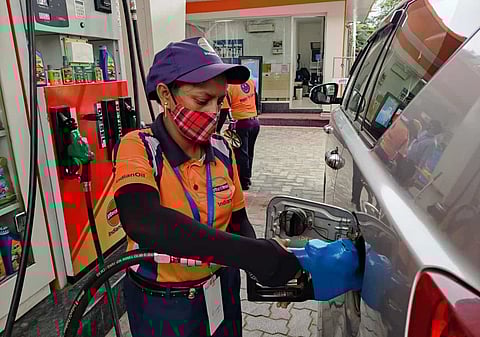

New Delhi: India’s petrol pump network has crossed the 1,00,000 mark, placing the country alongside the United States and China as the only nations with petrol retail networks of this scale, according to data from the Petroleum Planning & Analysis Cell (PPAC). As of end-November, India had 1,00,266 petrol pumps, making it the world’s third-largest network after the US and China, despite its significantly smaller geographical spread compared to the two countries.
Follow Energy Watch on X
India’s retail fuel footprint has nearly doubled over the past decade, expanding from 50,451 outlets in 2015, as state-owned oil marketing companies moved aggressively to defend market share and deepen fuel access across highways and rural regions amid rising vehicle ownership.
More than 90 percent of the country’s petrol pumps are operated by state-run firms — Indian Oil Corporation (IOC), Bharat Petroleum Corporation Ltd (BPCL) and Hindustan Petroleum Corporation Ltd (HPCL).
IOC alone operates 41,664 outlets, followed by BPCL with 24,605 stations and HPCL with 24,418 outlets, underscoring the dominance of public sector companies in fuel retailing.
India’s petrol pump count now puts it in the same global bracket as the US and China. The United States has the world’s largest petrol pump network, though there is no official count. A 2024 report estimated the number of retail gas stations at 1,96,643, though some outlets may have shut since then.
China ranks second, with a report last year pegging its network at 1,15,228 gas stations. China Petrochemical Corporation (Sinopec), the country’s largest fuel retailer, says it operates more than 30,000 in-service stations.
Despite China’s overall larger energy market, India’s largest retailer, IOC, operates a larger network of outlets than Sinopec.
Private fuel retailers continue to expand, though their share remains limited. Russia’s Rosneft-backed Nayara Energy is the largest private retailer with 6,921 outlets, followed by a joint venture of Reliance Industries Ltd and BP with 2,114 stations. Shell operates 346 outlets in India.
Private companies accounted for 5.9 percent of outlets in 2015; their share has since risen to 9.3 percent.
Rural petrol pumps now account for nearly 29 percent of India’s network, up from 22 percent a decade ago, reflecting a sustained push into underserved regions. Outlets are also evolving beyond petrol and diesel, with many now offering CNG and electric vehicle charging facilities.
Industry officials say private participation has remained constrained due to the government’s indirect control over fuel pricing through its majority ownership in public sector oil marketing companies.
Follow Energy Watch on LinkedIN
Even though pricing was deregulated a decade ago, state-run retailers halted daily price revisions in November 2021. At times, pump prices have also been kept below cost, making private retailing unviable.
The dense expansion of outlets has additionally reduced per-pump throughput, pushing some stations on low-traffic routes into losses.

