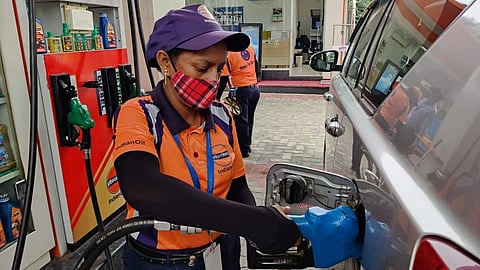

New Delhi: India's three state-owned Oil Marketing Companies (OMCs) — Indian Oil Corporation (IOC), Bharat Petroleum Corporation (BPCL) and Hindustan Petroleum Corporation (HPCL) — are collectively losing between Rs 1,000 crore and Rs 1,200 crore every day, according to a senior government official who spoke on the condition of anonymity. The losses have mounted over 10 weeks since the Middle East conflict broke out, with crude prices up 50 percent and retail fuel prices held at levels set two years ago.
Follow Energy Watch on X
The per-unit losses are Rs 14 per litre on petrol, Rs 42 per litre on diesel, and Rs 674 per cylinder on cooking gas LPG. Petrol continues to retail at Rs 94.77 a litre and diesel at Rs 87.67 a litre — unchanged for two years despite the sharp shift in global energy costs.
"At current oil prices, the losses in the current quarter (April-June) will wipe out the company's entire year's profit of about Rs 76,000 crore," he said, adding that when March — the first month of the crisis — is factored in, cumulative losses climb to approximately Rs 1 lakh crore.
Rating agency ICRA put numbers to the same concern. Prashant Vashisht, Senior Vice President and Co-Group Head, Corporate Ratings, ICRA Ltd, said: "The oil marketing companies are incurring substantial losses on the sale of auto fuels and domestic LPG owing to high international crude oil and product prices."
"ICRA estimates that at crude prices of USD 120-125 per barrel, and considering the past 10-year average crack spreads for auto fuels, oil marketing companies incur losses of around Rs 1,000 crore per day on the sale of auto fuels and domestic LPG. This level of losses is unsustainable and would need to be addressed if elevated crude oil and product prices persist over an extended period," he added.
Despite the financial strain, the OMCs have not blinked on supply. For 10 weeks, petrol, diesel and LPG have reached consumers without rationing or interruption — even as panic buying spiked demand — in sharp contrast to several global energy systems that either rationed supplies or passed steep price increases on to consumers. Countries from Japan to the United Kingdom have raised pump prices by as much as 30 percent since the West Asia conflict began.
The war has compounded the supply challenge considerably. India sources 40 percent of its crude oil imports, 90 percent of its cooking gas LPG and 65 percent of its natural gas from the affected region — and the OMCs have had to scramble to keep those lines intact.
The revenues OMCs earn from fuel sales are their only means of buying crude, building refining infrastructure and maintaining the distribution network that moves product to consumers. With that revenue-cost equation now deeply inverted, borrowings to meet working capital needs — primarily crude oil purchases — may have to rise.
The government has not stood entirely aside. Excise duty on petrol was slashed from Rs 13 to Rs 3 per litre, while diesel excise was cut to zero from Rs 10 per litre — a combined fiscal hit of Rs 14,000 crore a month for the exchequer. A Rs 60 per cylinder hike in domestic LPG prices was effected in March, though the official noted that even post-revision, cooking gas continues to be priced well below cost.
Follow Energy Watch on LinkedIN
On the road ahead, the official flagged that capital expenditure timelines may need recalibration if crude prices stay elevated, but drew a firm line around strategic priorities.
"If elevated crude prices persist for an extended period, OMCs may require higher working capital borrowings and calibrated reprioritisation of some capex timelines," he said. "However, strategic investments in refining expansion, energy security infrastructure, ethanol blending, biofuels, and transition fuels continue to remain national priorities and are expected to proceed with Government support."

