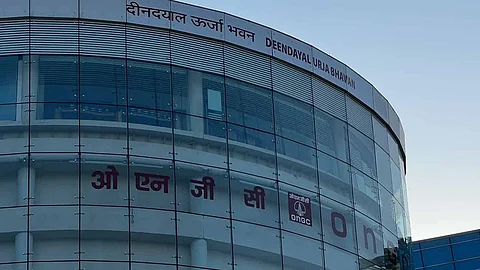


New Delhi: The board of Oil and Natural Gas Corporation (ONGC) has given in-principle approval for a 1.75 MMT strategic petroleum reserve (SPR) at Mangalore, a decision the company flagged as a project of national importance in a filing to the stock exchanges dated July 9. The approval came at a board meeting held the same day.
Follow Energy Watch on X
In the filing, ONGC said the board accorded "an in-principle approval for the development of 1.75 MMT capacity Strategic Petroleum Reserves as a project of national importance along with associated facilities at Mangalore (Phase-I Extension) as per the directives of Ministry of Petroleum and Natural Gas (MoP&NG)."
The board also directed the company "to take up with the Government of India for broadening commercial utilisation opportunity with associated regulatory support," according to the filing. The disclosure did not specify the project cost or a completion timeline.
Commercial utilisation of strategic storage typically involves leasing cavern space to oil companies and trading crude, an arrangement India has already used at Mangalore. Under a 2018 agreement, the UAE's Abu Dhabi National Oil Company (ADNOC) leases about 0.75 MMT of storage in the existing 1.5 MMT Mangalore cavern from ISPRL, with New Delhi retaining the right to draw on that crude during a national emergency. ONGC's Mangalore Refinery and Petrochemicals Ltd (MRPL) subsidiary, which operates a refinery in the region, could be integrated with the new caverns, according to sources.
The approval comes as India works through the fallout of the West Asia crisis, which has kept its energy-security exposure in sharp focus. Coordinated US and Israeli airstrikes on Iran in late February triggered the near-total closure of the Strait of Hormuz, the chokepoint through which roughly a fifth of global oil supply normally moves. The Indian crude basket nearly doubled within a month, rising from about USD 69 a barrel in February to USD 126 in March and peaking near USD 157.
India's three state-run Oil Marketing Companies (OMCs) took a heavy hit from holding pump prices steady through the shock. Petroleum Minister Hardeep Singh Puri disclosed that the companies absorbed about Rs 74,781 crore in losses during the crisis. Prices have since eased but remain volatile; Brent crude was close to USD 79 a barrel on July 9 after fresh US strikes on Iran. India's structural vulnerability a concern, with the country importing more than 88 percent of its crude requirement.
India's existing SPRs, operated by Indian Strategic Petroleum Reserves Ltd (ISPRL), hold a combined 5.33 MMT across three underground sites. These are Visakhapatnam (1.33 MMT), Mangalore (1.5 MMT) and Padur (2.5 MMT). The Centre has separately approved an additional 6.5 MMT of commercial-cum-strategic storage at Chandikhol in Odisha (4 MMT) and Padur (2.5 MMT) as the next phase of expansion.
Follow Energy Watch on LinkedIN
The current stockpile is modest against international benchmarks. The International Energy Agency (IEA) recommends that countries hold emergency oil stocks equivalent to at least 90 days of net imports, while India's 5.33 MMT is estimated to cover about nine and a half days of crude requirement on 2019-20 consumption levels. ONGC is the first public sector energy company in India to directly fund the creation of a strategic crude storage facility.
