
New Delhi: The Supreme Court on Friday dealt a decisive blow to the Uttar Pradesh government, ruling that the state has no authority to impose local Value Added Tax (VAT) on natural gas transported from Andhra Pradesh through common carrier pipelines. The ruling dismissed a batch of appeals filed by the UP government and upheld a 2012 Allahabad High Court order that had struck down the state's tax assessment orders against Reliance Industries Limited and other large buyers, including Tata Chemicals and IFFCO.
Follow Energy Watch on X
A bench of justices JK Maheshwari and Atul S Chandurkar held that the transactions in question constituted interstate sales governed exclusively by the Central Sales Tax Act, and that the state legislature had no jurisdiction to tax them.
"We do not find any valid reason to interfere with the well-reasoned judgment of the High Court. It needs to be observed that High Court's order is in line with the constitutional scheme and statutory mandate, which was not dispelled by the Appellant (state government) herein. Accordingly, the appeal is dismissed," said Justice Maheshwari, who authored the 94-page judgment for the bench.
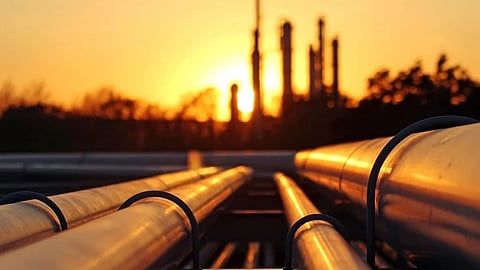
The case centred on natural gas extracted from the KG-D6 basin off the coast of Andhra Pradesh. Under the Gas Sales and Purchase Agreements, the delivery point — where title and risk in the gas passed to buyers — was at Gadimoga in Andhra Pradesh. The gas was subsequently transported through a network of pipelines running through Gujarat and into Uttar Pradesh.
UP's tax authorities had argued that because natural gas is a fungible commodity that gets co-mingled with gas from other sources in a pipeline, it remains "unascertained" until it is metered and appropriated at buyers' factories within the state. On this basis, UP claimed the transaction was a local, intra-state sale liable to state VAT at a rate of 21 percent.
The Supreme Court rejected this reading as overly technical. It held that a sale qualifies as an "inter-state sale" under Section 3 of the Central Sales Tax Act if the contract of sale occasions the movement of goods from one state to another.
"The movement of gas was directly occasioned by the contract of sale... thereby satisfying all essential requirements of an inter-state sale," the bench said.
The court further noted that a 2016 amendment to the CST Act had been specifically enacted to clarify that gas transported through common pipelines retains its character as an interstate sale despite co-mingling. The bench held the amendment was "clarificatory" and "inserted by way of abundant caution," making it applicable even to disputes predating 2016.
The court also rejected UP's argument on the interpretation of tax statutes, holding that such statutes must be read strictly, with words given their natural meaning — neither expanding nor contracting their scope.
"Moreover, we need to keep in mind that in the garb of interpretation, the judiciary cannot amend the provisions of the Constitution of India, which has been carefully drafted," the bench said.
The judgment invoked broader constitutional principles on the nature of India's federal structure and the importance of unimpeded interstate trade. The bench noted that India is a union of states where economic endowments are unequal, and that free trade serves to offset some of those disparities.
"The reality is that all states are not endowed equally. There is stark disparity in the economic scenario among various states. Each state has its unique contributions and products. It is the free flow of trade and commerce that seeks to nullify some effects of inequality with just exceptions," the court said.
It cautioned that constituent states would be tempted to adopt protectionist measures to strengthen their own revenues at the expense of others, and said it was precisely to guard against this that the Constitution vests fiscal powers over interstate and international trade in the Union government.
"It is in this context that the framers of the Constitution have laid down a road map to ensure that the Union government takes over fiscal policies touching upon inter-state or international trade and commerce. This avowed purpose, we are here to secure," it said.
Follow Energy Watch on LinkedIN
The bench underscored that under Article 269(1) of the Constitution, the Centre alone has the power to levy and collect tax on the sale or purchase of goods in the course of interstate trade, while Article 286(1) bars state legislatures from taxing supplies that take place outside their borders.
"The courts in India are given the responsibility to preserve this balance as envisaged by the framers of our Constitution. Any interference in balancing would be detrimental to the spirit of the Constitution," it said.

