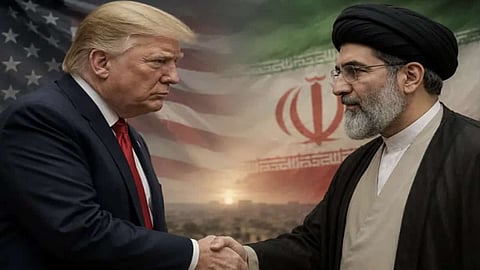


New Delhi: US President Donald Trump said the United States and Iran have finalised an agreement to end a 107‑day war that sparked a global energy crisis. Pakistan’s prime minister, Shehbaz Sharif, said his country will host the signing ceremony in Switzerland on June 19, but officials have yet to disclose the deal’s full terms.
“The Deal with the Islamic Republic of Iran is now complete. Congratulations to all,” Trump wrote on Truth Social, saying the agreement would reopen the Strait of Hormuz — the narrow waterway that carries about one‑fifth of the world’s oil — and end the US naval blockade of Iranian ports. He later clarified that the strait would reopen on Friday after the official signing.
Follow Energy Watch on X
The announcement capped a fraught week of diplomacy and military action that included US strikes on Iranian targets and a last‑minute decision by Trump not to seize Kharg Island, Iran’s main oil export hub. Speaking of the agreement, Trump called it “a Great Deal” that he said would bring peace and security to the region.
Iranian officials said implementation will be conditional and reciprocal. Foreign Ministry and deputy foreign ministry spokesmen said Tehran expects the US to carry out its obligations, including measures related to sanctions relief and a halt to Israeli strikes against Lebanon. Iran confirmed the signing ceremony is scheduled for Friday and said a 60‑day negotiation period will follow to work through nuclear and sanctions issues.
International reactions were mixed. UN Secretary‑General António Guterres welcomed the announcement as a “critical step” toward peace. US Vice‑President J. D. Vance and several US and Pakistani lawmakers praised the deal but stressed the need for verification. Vance told Fox News that benefits hinge on Iran fulfilling its commitments. Indian‑American Congressman Ro Khanna said the pact reportedly includes a mutual‑sovereignty provision.
Israel signaled caution. Defence Minister Israel Katz said Israeli forces would remain in southern Lebanon and warned that any Iranian strike would be met with “great force.”
Follow Energy Watch on LinkedIN
Pakistan, on the other hand has proposed to host the signing ceremony of the deal between the US and Iran in Switzerland on June 19. Notably, Pakistan tried to act as a mediator alongside Qatar and others, but failed miserably in bringing the warring countries on the negotiation table.
Pakistani officials however have said that the mediators will facilitate pre‑implementation technical meetings this week.
Analysts warned that the market and geopolitical effects depend on implementation. Pakistan’s deputy prime minister and foreign minister, Ishaq Dar, said the agreement could stabilise markets and ease pressure on vulnerable economies, but other commentators noted that tanker traffic and oil flows may not return immediately to pre‑conflict levels.
Background and outstanding issues
Negotiations were mediated by Pakistan and Qatar; a two‑week ceasefire agreed on April 8 was extended while talks continued.
The deal reportedly addresses Iran’s nuclear constraints and sanctions relief, but officials have not released the text.
The US and Israel launched strikes on Iran on February 28 that killed Supreme Leader Ayatollah Ali Khamenei and senior commanders; Khamenei’s son Mojtaba — named the new supreme leader — has not appeared in public since the war began.
Follow Energy Watch on LinkedIN
What has to be watched is the 60‑day follow‑up negotiations on nuclear and sanctions matters, and concrete verification measures. Also, whether tanker traffic resumes quickly through the Strait of Hormuz and whether Iran’s oil exports are restored at scale. Responses from regional actors, notably Israel and Saudi Arabia, and potential domestic political fallout in the US and Iran also is yet to be seen.
