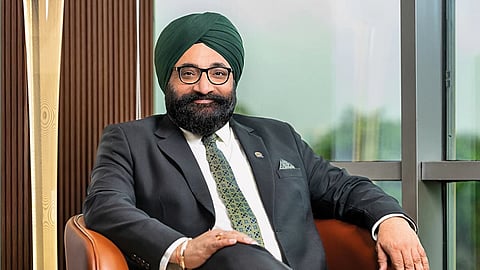


New Delhi: Indian Oil Corporation's (IOC) Chairman AS Sahney said on Monday that the West Asia conflict had reinforced a lesson for the company — resilience has to be built before it is tested. "This experience has reinforced an important lesson: resilience has to be built before it is tested," he said at the company's 67th Annual General meeting. "In an uncertain world, energy security depends not only on scale, but equally on agility, diversification and preparedness."
Follow Energy Watch on X
The lesson came out of a year that did not end quietly. "Towards the close of FY 2025-26, and continuing into the current financial year, events in West Asia have reminded us how quickly the global energy landscape can change," Sahney said. India imports more than 88 percent of its crude oil requirement. Around 45 percent of those imports and nearly 90 percent of imports of Liquefied Petroleum Gas (LPG) move through the Strait of Hormuz, where maritime trade has been disrupted by the conflict.
That has left the company with a clear objective, said the Chairman. "For Indian Oil, the priority during this unprecedented crisis has remained crystal clear — to maintain continuity of energy supplies despite constrained sourcing options and volatile international markets," Sahney said.
The response ran through crude sourcing and refinery scheduling at the same time. Teams diversified sourcing, realigned refinery operations and strengthened supply-chain coordination "to secure alternate supplies, optimise cargo movements and rebalance products across regions," Sahney said. He credited 24x7 control rooms, daily reviews and real-time market monitoring with closing emerging gaps as they appeared. The monitoring was done with guidance from the Ministry of Petroleum and Natural Gas, he said.
The operating numbers held through the switch. Despite what Sahney described as a significant shift away from Middle Eastern crude grades, refineries ran above 100 percent utilisation and LPG production was raised by nearly 30 percent within a short period. The gas business secured additional liquefied natural gas (LNG) from diversified geographies while maintaining supplies to priority sectors.
The cost of that crude, however, showed up in the first quarter of 2026-27. "While profitability during the quarter remained under pressure from higher crude costs arising from the West Asia conflict, the strength of our operating performance gives us confidence in the underlying resilience of your Company," Sahney said. Refineries processed a record 19.17 million metric tonnes (MMT) of crude at 109.4 percent capacity utilisation in the June quarter of FY27. Pipelines recorded their highest-ever quarterly throughput of 28.55 MMT, and the domestic market share in petroleum product sales rose to 43.1 percent.
For the full year 2025-26, the company reported a turnover of around Rs 8.86 lakh crore and a standalone net profit of Rs 36,802 crore on aggregate sales of over 105 MMT across petroleum products, natural gas and petrochemicals. Refineries recorded their highest-ever crude throughput of 75.45 MMT and liquid pipelines their highest-ever throughput of 102.52 MMT. Domestic petroleum product sales reached 88.97 MMT.
Expansion at three refineries is the next phase. Panipat is going from 15 to 25 million metric tonnes per annum (MMTPA), Gujarat from 13.7 to 18 MMTPA and Barauni from 6 to 9 MMTPA. "Together, these projects will take Indian Oil's group refining capacity from 80.75 MMTPA to around 98 MMTPA," Sahney said.
He placed that against the national build-out. "The scale of this expansion is significant in the national context. As India moves towards 300 MMTPA of refining capacity, Indian Oil alone will contribute more than 40 percent of the incremental capacity, strengthening the country's ability to meet rising energy demand while deepening our petrochemical integration."
Supporting infrastructure moved alongside. Augmentation of the Salaya–Mathura crude oil pipeline was completed during the year and the new Mundra–Panipat crude oil pipeline is nearing completion. The 2,805-km Kandla–Gorakhpur LPG pipeline is being developed through joint venture IHB Limited, and the company describes it as the world's longest LPG pipeline. The Kandla–Bhopal section is complete.
Petrochemicals sales touched a record 3.40 MMT, and the Acrylics and Oxo-Alcohol project at Gujarat Refinery took the company into high-value petrochemicals. "Looking ahead, we aim to progressively raise our Petrochemical Intensity Index to about 15 percent by 2030," Sahney said.
Natural gas sales reached a high of 7.09 MMT and the city gas distribution business turned earnings before interest, taxes, depreciation and amortisation (EBITDA) positive. The company has set a target of increasing natural gas sales 1.5 times by 2030 and raising upstream integration to over 10 percent by 2031. Commercial gas production began from its coal bed methane block in Jharkhand, first oil came from the Jyoti-1 and Jyoti-2 wells in Gujarat, and two oil discoveries were made at Shilaif and Habshan in Abu Dhabi.
Product exports rose to 5.21 MMT in 2025-26, with supplies to neighbouring countries growing by over 10 percent. The company has since signed a long-term agreement with the State Trading Corporation of Mauritius to meet that country's entire import requirement of motor spirit, high-speed diesel and aviation turbine fuel.
On the transition side, Sahney said the company had become the first in India to receive ISCC CORSIA certification for sustainable aviation fuel (SAF) production at Panipat through the co-processing route. Construction has begun on a large-scale green hydrogen plant at Panipat. Through Terra Clean Limited, 1 GW of renewable energy capacity is under development with another 4.3 GW under preparation. "Our approach remains pragmatic — scaling solutions that are commercially viable while ensuring that sustainability and value creation move together," he said.
The company's transformation programme, SPRINT, was cited for a best-ever refinery Energy Intensity Index of 90.1, with Panipat and Mathura reaching Quartile-1 in Solomon benchmarking for the first time. LPG bottling costs fell 12 percent and aviation operating costs 8 percent. Cost-optimisation initiatives generated savings of over Rs 2,000 crore during the year.
Capital expenditure stood at Rs 32,405 crore in 2025-26 while the debt-to-equity ratio improved to 0.54 from 0.75. The shareholder base has grown to nearly 29 lakh, from around 6 lakh at the start of the decade.
"During 2025-26, Indian Oil implemented over 700 CSR projects, with an expenditure of Rs 488.63 crore, focusing significantly on health and nutrition, Aspirational Districts and the PM Internship Scheme," Sahney said, referring to corporate social responsibility spending.
Follow Energy Watch on LinkedIN
He closed on the company's mandate. "Our responsibility goes beyond delivering energy — it is to support India's growth, strengthen the nation's energy security and contribute meaningfully to the journey towards a Viksit Bharat."
