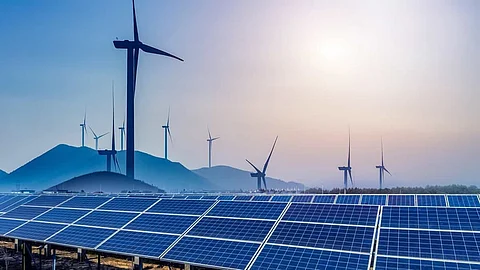


India’s Renewable Energy (RE) transition is extraordinary in scale. In FY 2025–26, as of end December 2025, the nation added a record ~37 GW of new renewable capacity, lifting cumulative RE to about 258 GW — with solar accounting for ~30 GW of the additions and wind ~4.47 GW — marching ahead to achieve the highest annual increase of RE capacity during any financial year in Indian history.
Follow Energy Watch on X
Despite these headline achievements, a deeper systemic bottleneck is emerging: the ‘Twin Last-Mile Problem’ that threatens the reliability and economic viability of the entire grid integration process. This is not a single issue — it is two distinct, interlocking failures in transmission evacuation and DISCOM absorption that must be addressed separately and urgently.
Renewable energy resources are, by nature, geographically concentrated: wind in western and southern states, solar in the sun-belt of Rajasthan, Gujarat, and others. Yet load centres are dispersed and often far from these resource hubs. The core challenge is getting electrons from where they are generated to where they are needed — a known grid engineering problem that has not been solved at the necessary pace.
Power transmission is a critical component of the electricity value chain, and a robust and resilient network is essential for integrating increasing RE capacity into the grid. Historically, India’s power transmission network has been among the most advanced in the world, characterised by proactive planning and upgrades that resulted in minimal congestion and strong operational performance. However, the significantly shorter gestation periods of RE installations have left the transmission network struggling to keep pace with RE deployment. The result is a growing gap between renewable power generation and the availability of energy evacuation infrastructure. The consequence: renewable projects operate below potential, and what could be clean, firm power remains artificially constrained by inadequate evacuation infrastructure.
This has prompted power regulators to ramp up their transmission planning efforts. It is expected that by 2032, around 600 GW of renewable capacity will be integrated into India’s power grid.
India’s transmission planning, which earlier remained largely reactive — utilities building lines after generation is auctioned and commissioned — is now shifting to potential-based planning, with plans to be revised every six months to reflect continuously evolving ground realities.
If transmission is the current physical bottleneck, DISCOMs are the economic bottleneck. Even when renewable power reaches the grid, many DISCOMs lack the institutional framework and financial incentives to integrate that power efficiently.
State DISCOMs are central to the survival of a project. Once RE projects are awarded, it falls on state DISCOMs to sign Power Purchase Agreements (PPAs) and Power Sale Agreements (PSAs). And this is where the system gets hammered by delays. Cash-strapped DISCOMs — sitting on a huge debt pile — are reluctant to lock into long-term fixed tariffs. They expect prices to fall further, especially when cheaper short-term market power or existing thermal contracts are available. This has been a major point of pain for renewable energy developers.
Unsigned PPAs have seen developers suffer heavy financial losses, creating business uncertainty and making projects less viable. Such backlogs trigger cascading delays, pushing project timelines months beyond targets, inflating costs, and eroding investor confidence.
The issue is not ideological resistance to clean energy. It is structural. Solar generation often peaks during midday, creating surplus energy that provides little value to DISCOMs burdened with fixed thermal contracts and peak demand in evenings and mornings. RE penetration exacerbates revenue shortfalls under traditional tariff designs and cross-subsidy structures, squeezing utility cash flows without compensating them for the flexibility that variable generation demands.
If DISCOMs are expected to manage variable RE generation without adequate tools, the cost is eventually passed on to consumers; if not, the government ends up bailing them out. Structurally, it is better if tenders evolve into hybrid and RTC tenders, with Wind + Solar + BESS as the ultimate solution to provide cost-effective round-the-clock green power. Such a shift would improve grid reliability while ensuring more dependable power for consumers.
India’s progress toward its 2030 target of 500 GW of non-fossil capacity is laudable, but system integration is now the real test. Even with ~258 GW installed, RE capacity factors, grid penetration, and economic utilisation remain constrained when transmission and DISCOM absorption lag.
Without structural reform:
• Excess RE capacity risks becoming stranded behind bottlenecks.
• DISCOM financial stress will deepen as they juggle solar surpluses and peak capacity obligations.
• Curtailment will persist as a “solution,” masking deeper market failures.
Move to generation-led, Renewable Energy Zone (REZ) planning, where evacuation capacity is built in anticipation of resources, not in response to auction outcomes. Institutional coordination between CTU and STUs must be incentivised and performance-monitored.
Energy-only PPAs must be supplemented with firm, round-the-clock (RTC) contracts, where capacity and flexibility are valued distinctly. DISCOMs must be enabled to procure energy, capacity, and flexibility. This segmentation helps align procurement with value rather than just volume.
Storage, demand response, and flexible generation need clear market products and payment structures. Without transparent pricing for flexibility, renewable integration simply shifts costs to other parts of the system.
Time-of-day tariffs should reflect system stress and surplus periods. This requires political courage and targeted consumer communication.
India’s renewable achievements reflect technological competitiveness and policy ambition. But the real measure of success will be not just how much capacity we build, but how well we integrate it into the grid and the economy. A comprehensive state-wise green power transmission roadmap is essential to ensure that all RE-rich states can sustainably integrate future RE capacity additions. Moreover, given the ongoing rise in electricity demand and land prices, the roadmap must prioritise overbuilding of transmission assets, even at the cost of initial underutilisation.
Transmission planning and operations must leverage advanced forecasting, load-flow modelling, and real-time monitoring to enhance predictability and operational efficiency. Ultimately, a modern and robust transmission network will form the invisible backbone of India’s power sector — one that is flexible, resilient, and fully aligned with the country’s long-term decarbonisation goals.
Follow Energy Watch on LinkedIN
The twin last-mile problems of transmission and DISCOM absorption are solvable — but only if they are recognised as distinct policy challenges requiring targeted institutional and market reforms. Continuing to treat them as a single “grid issue” risks derailing India’s clean energy transition at precisely the moment when high penetration enters operational reality.
India doesn’t need less ambition in RE — it needs better systems to deliver on that ambition.
Disclaimer: This is an Op-ed article. The opinions expressed in this article are the author's own. Energy Watch does not endorse nor support views, opinions or conclusions drawn in this post and we are not responsible or liable for any content within the article or for any damage or loss caused by and in connection to it.
