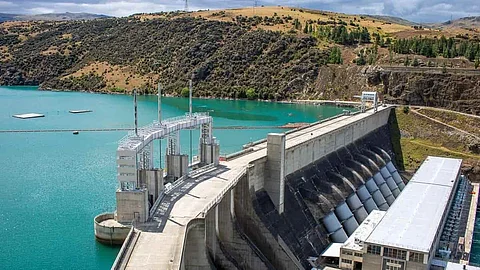


New Delhi: Four strategically important hydroelectric projects (HEPs) being built on the Chenab River in Jammu & Kashmir's Kishtwar district — Pakal Dul, Kiru, Kwar and Ratle — face a combined cost overrun of Rs 5,737 crore and an average delay of about three and a half years, based on figures placed before the Rajya Sabha on Monday.
Follow Energy Watch on X
The escalation is concentrated on two of the four: Pakal Dul and Kiru HEPs. Their combined sanctioned cost of Rs 22,208 crore has risen to an anticipated Rs 27,945 crore. On the other hand, Kwar and Ratle HEPs report no cost overrun. The delays span a wide range, from about 16 months on Kwar to nearly seven years on Pakal Dul. The figures were given by Minister of State for Power Shripad Yesso Naik in a written reply to a question raised in Rajya Sabha on the first day of Monsoon Session of Parliament.
Pakal Dul (1,000 MW), the largest of the four and J&K's first storage project, accounts for the bulk of the overrun: its cost has risen about 57 percent to Rs 12,728 crore, and it is now due in March 2027 against an original schedule of April 2020. Kiru (624 MW) is up about 26 percent at Rs 5,409 crore, now due in March 2027 against September 2023.
Naik said "No cost overrun is anticipated" for Kwar (540 MW) and Ratle (850 MW), whose costs stay at Rs 4,526 crore and Rs 5,282 crore, respectively. Both have still slipped in terms of timelines — Kwar to March 2028 from November 2026, and Ratle to November 2028 from February 2026.
The reasons vary by project, according to the reply. For Pakal Dul, Naik cited an "Initial delay due to court case during tendering process," the impact of the Covid-19 pandemic, and a "Major Slope Failure at Adit Tunnel site of Tunnel Boring Machine (TBM)," along with a labour union strike, delays in providing encumbrance-free land, and agitations by local residents and project-affected families.
Kiru's delays were attributed to Covid-19, road damage due to flooding and local issues, and the "Delayed supply of parts of dam tower crane from different countries during Covid-19 pandemic." For Kwar, the reply cited a "Delay in award of Hydro-Mechanical (HM) and Electro-Mechanical (E&M) packages of the project," and labour strikes.
Ratle's delays were traced to "High monsoon discharge breached dykes, flooding of diversion tunnels," and to "Controlled and restricted blasting at dam due to inhabited areas which affected progress of excavation," besides labour strikes and land-related disturbances.
Pakal Dul, Kiru and Kwar HEPs are being developed by Chenab Valley Power Projects Limited (CVPPL), a joint venture of NHPC Limited and Jammu & Kashmir State Power Development Corporation Limited (JKSPDCL), in Kishtwar district. Ratle is being developed separately by Ratle Hydroelectric Power Corporation Limited (RHPCL), a joint venture in which NHPC and JKSPDC hold 51 percent and 49 percent respectively, with construction undertaken by Megha Engineering and Infrastructure Limited (MEIL) and the electromechanical works by BHEL.
On the CVPPL projects, a joint venture of Afcons and Jaiprakash Associates was awarded the Pakal Dul powerhouse civil works, with L&T contracted for the head race tunnel boring and Voith Hydro supplying the turbines. Kiru and Kwar are being executed by Patel Engineering. Pakal Dul is being built on the Marusudar river, a tributary of the Chenab, while Ratle is located at village Drabshalla in Kishtwar.
Follow Energy Watch on LinkedIN
The projects carry strategic weight because of the river they sit on. The Chenab's waters were allocated to Pakistan under the Indus Waters Treaty of 1960, which permitted India non-consumptive uses such as run-of-the-river hydropower. After the terrorist attack in Pahalgam on April 22, 2025 that killed 26 people, India placed the treaty in abeyance and moved to accelerate the Kishtwar projects.
