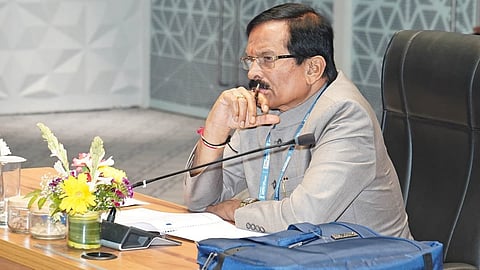

New Delhi: States have requested the Central government to bring in a mandate for cost-reflective tariffs or “clear policy rules that bind Regulators” to ensure timely, cost-based pricing, during a meeting of the Group of Ministers on DISCOM viability held at the Bharat Electricity Summit 2026. The sixth meeting of the Group of Ministers, chaired by Shripad Yesso Naik, focused on addressing structural and financial challenges in electricity distribution utilities.
Follow Energy Watch on X
The meeting saw participation from energy ministers of Uttar Pradesh, Madhya Pradesh and Rajasthan, along with senior officials from Central and state governments, state utilities and Power Finance Corporation (PFC).
Naik said that for the first time, India’s power distribution utilities have turned “a sector-wide profit,” driven by reductions in AT&C losses and the ACS-ARR gap. However, he cautioned that “the gains achieved so far are notable, yet they remain fragile in nature and unevenly distributed across utilities and regions.”
“Despite recent improvements, roughly half of distribution utilities remain loss-making,” he said, adding that the sector continues to be burdened with “heavy debt and sizeable, recurrent accumulated losses.”
“The recent gains show that we are finally on the right path, but they also underline that we are still far from where a truly healthy power sector needs to be,” he added.
Naik highlighted that “non-cost reflective tariffs, compounded by delays in subsidy release,” are pushing DISCOMs into “a cycle of expensive short-term borrowing to simply keep operations afloat.” He warned that “distorted cross-subsidies are propelling industrial and commercial consumers to migrate to open access,” which is “eroding the very revenue base DISCOMs rely on.”
“These trends are flashing a clear warning,” he said, noting that continued financial stress is feeding into “deteriorating service quality and a vicious cycle of decline.”
Naik said reforms must rest on three pillars to ensure long-term viability. “The first pillar is regulatory discipline: timely and cost-reflective tariffs with automatic FPPCA pass-through and a clear glide path to sharply reduced cross-subsidies,” said the minister. “The second pillar is decisive Government action: comprehensive restructuring of DISCOM debt coupled with truly professional, arm’s-length management of distribution utilities.”
“The third pillar is utility-led excellence: relentless operational efficiency driven by smart metering, digitalisation, and data-backed loss reduction across the network.”
He stressed that “financial viability is not optional but foundational to the power sector,” adding that without it, “India’s energy transition and the vision of Viksit Bharat will be very difficult [to] materialise.”
Deliberations during the meeting indicated that states “broadly endorse the Group of Ministers’ recommendations,” signalling alignment on the next phase of reforms. It was agreed that “chronic DISCOM inefficiencies impose a steep annual drag on the economy,” with cumulative losses running into “multiple lakh crore rupees over recent years.”
States also explicitly sought central support for DISCOM debt restructuring, with such assistance to be “reform linked.” They further called for a follow-up meeting to define “clear action points for every stakeholder” and issue “time-bound directions to drive implementation on the ground.”
In her welcome address, the CMD of Power Finance Corporation said DISCOMs face “deep-rooted, long-term risks from persistent structural, financial, and operational inefficiencies that undermine sustainable, quality supply.” While acknowledging that “progress has been tangible in select areas,” she said “entrenched structural weaknesses continue to cast a long shadow over sustainable outcomes.”
“Generation and transmission can perform at their peak only when the distribution segment is financially robust and operationally sound,” she noted, adding that, “only truly creditworthy DISCOMs can unlock the long-term investment the power sector needs.”
In his closing remarks, Naik said the Group’s recommendations would “substantially shape the core provisions on distribution sector reforms.” He urged states to push ahead with structural reforms so that they move “from being a major part of the challenge to leading the solution.”
Follow Energy Watch on LinkedIN
The Group of Ministers reiterated its commitment to take necessary measures to improve the financial viability of distribution utilities, signalling a coordinated push to address one of the power sector’s most persistent challenges.

