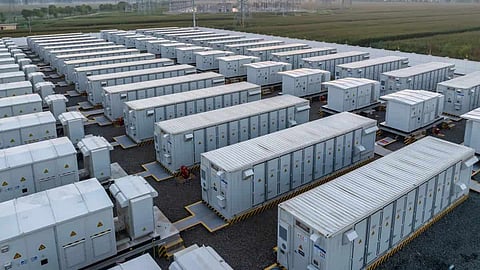

New Delhi: The Union Cabinet, chaired by Prime Minister Narendra Modi, on Wednesday approved a Viability Gap Funding (VGF) Scheme for Development of Grid-Scale Energy Storage Systems, with total financial support of Rs 14,500 crore. The support will run from financial year 2026-27 to 2030-31, according to an official statement. It will back 92 GWh of storage capacity that is yet to be commissioned. Of this, 60 GWh will come from hydro pumped storage plants (PSP), 30 GWh from battery energy storage systems (BESS) and 2 GWh from alternative technologies. The statement put the total estimated investment at Rs 97,600 crore.
Follow Energy Watch on X
The new capacity will be equivalent to 170 percent of India’s present-day grid-scale energy storage capacity, the statement said. The government also said the scheme will help meet the country’s required grid-scale storage capacity of 411 GWh by 2031-32.
Union Information and Broadcasting Minister Ashwini Vaishnaw announced the decision at a media briefing after the Cabinet meeting. He said the major benefit of storage would come in transmission. “Because of storage, we can increase our existing transmission capacity multiple times,” Vaishnaw said.
He explained the point with the example of a solar park that has 10 megawatts (MW) of evacuation capacity. “That 10 MW is never fully utilised, because solar energy will not come at night. That’s why the investment we have to make in energy transmission capacity is higher if there is no storage. If you have storage, then you can utilise the full 10 MW capacity along with the renewable energy generation,” he said.
Pumped storage accounts for 60 GWh of the 92 GWh. Vaishnaw described how the technology works. “When energy is generated from solar, it is used to run pumps and store water at a higher altitude. The water is then made to flow from the higher altitude to a lower altitude, and energy is generated again from the kinetic energy,” he said.
The remaining 2 GWh has been kept for technologies that are not yet in wide use. “If a new technology comes, such as ultra-capacitor technology, there will be 2 GWh for emerging technology,” Vaishnaw said.
Storage capacity will be allocated through tariff-based competitive bidding, according to the statement. Public and private sector electricity distribution companies (discoms) will be eligible for VGF support for BESS and hydro PSP projects. Projects based on alternative storage technologies will be implemented by public and private sector entities, the statement said.
Vaishnaw said the scheme will be implemented together with state governments. “Proper care will be taken that the scheme is distributed across the country,” he said.
BESS projects under the scheme will have to meet a minimum domestic content requirement (DCR) of 40 percent, the statement said. The government said the scheme seeks to strengthen India’s domestic energy storage manufacturing through demand-side financial support and to reduce dependence on imported components. According to the statement, the requirement will complement existing supply-side incentives for battery manufacturing.
Follow Energy Watch on LinkedIN
The government said wider use of grid-scale storage will allow greater utilisation of renewable energy and help address the variability of renewable generation. It will also reduce dependence on conventional generation for balancing round-the-clock power supply, according to the statement.
