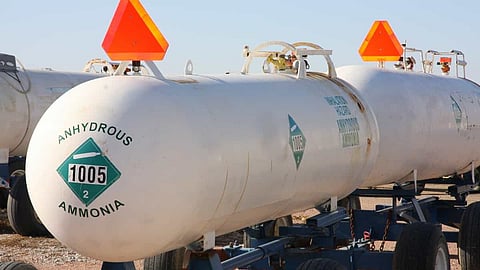


New Delhi: The government has notified emission standards for green ammonia and green methanol, establishing the conditions under which the fuels can be classified as “green” under the National Green Hydrogen Mission. In separate notifications dated February 27, the Ministry of New and Renewable Energy (MNRE) defined emission thresholds and eligibility conditions for the two hydrogen derivatives.
Follow Energy Watch on X
The notifications state that “Green Ammonia” means ammonia (NH₃) produced using Green Hydrogen, while “Green Methanol” means methanol (CH₃OH) produced using Green Hydrogen.
The notification specifies a strict emissions cap for green ammonia production. “The total non-biogenic greenhouse gas emissions arising from the production of Green Hydrogen, ammonia synthesis, purification, compression, and on-site storage shall not exceed 0.38 kilogram of carbon dioxide equivalent per kilogram of ammonia (kg CO₂ eq/kg NH₃), taken as an average over the last 12-month period,” the MNRE order states.
Renewable energy used in the production process may also include electricity generated from renewable sources that is stored in an energy storage system or banked with the grid in accordance with applicable regulations.
For green methanol, the government has set a separate emissions threshold covering the entire production chain. “The total non-biogenic greenhouse gas emissions arising from Green Hydrogen production, methanol synthesis, purification, and on-site storage shall not exceed 0.44 kilogram of carbon dioxide equivalent per kilogram of methanol (kg CO₂ eq/kg CH₃OH), calculated as an average over the preceding 12-month period,” the notification states.
The order also allows carbon dioxide used in methanol synthesis to be sourced from multiple pathways. “In the Green Methanol synthesis process, carbon dioxide may be sourced from biogenic sources, Direct Air Capture (DAC), or existing industrial sources,” the notification states, adding that MNRE may revise eligible CO₂ sources in the future with prospective applicability and appropriate grandfathering provisions.
The ministry said detailed procedures for certification will be issued separately. “A detailed methodology for measurement, reporting, monitoring, onsite verification, and certification” of green ammonia and green methanol will be specified by MNRE.
The orders also clarify that tenders, bids or solicitations issued before the date of the notifications may continue under their existing terms, although procuring entities may align them with the new standards where feasible and with mutual consent of the parties.
Follow Energy Watch on LinkedIN
The notification extends India’s regulatory framework for green hydrogen to cover downstream derivatives, such as, ammonia and methanol.
These fuels are expected to play a role in decarbonising sectors, including fertilizers, shipping, power generation and heavy industry, while also supporting India’s ambitions to become a producer and exporter of green hydrogen derivatives under the National Green Hydrogen Mission.
