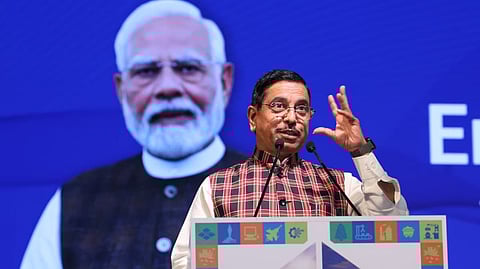

New Delhi: India has set a new global benchmark in green hydrogen pricing, with discovered prices falling to Rs 279 per kg under the National Green Hydrogen Mission, Union Minister for New and Renewable Energy Pralhad Joshi said on Tuesday. Addressing the inaugural Mumbai Climate Week, Joshi said, “Under the National Green Hydrogen Mission, India has set a new global benchmark in green hydrogen pricing, with discovered prices falling to Rs 279 per kg.”
Follow Energy Watch on X
He added that the discovery of “globally competitive green ammonia pricing” further reinforces India’s leadership in emerging clean fuel markets.
The Rs 279/kg price marks a historic low and positions India among the most cost-competitive green hydrogen producers globally, with European prices currently more than twice this level. The price was discovered through a competitive tender for a 10,000 tonnes per annum Green Hydrogen Generation Unit (GHGU) at Numaligarh Refinery Limited in Assam.
NeuEn Green Energy — a joint venture between Bharat Petroleum Corporation Limited and Sembcorp Industries — emerged as the lowest bidder at Rs 279/kg. Importantly, the winning bid was not an outlier. The tender also saw competitive bids at Rs 280/kg and Rs 281/kg, indicating strong market depth and cost convergence at sub-Rs 300/kg levels.
The project will be executed on a Build, Own and Operate basis, with the selected developer supplying gaseous green hydrogen to the refinery for 25 years. The scope includes design, engineering, construction, commissioning, and long-term operations and maintenance.
Joshi said India’s climate ambition is translating into “decisive climate action on the ground.” At the national level, he informed that India is set to cross 30 lakh beneficiary households under PM Surya Ghar: Muft Bijli Yojana this week, describing it as “a major step in scaling distributed rooftop solar across the country.”
India’s non-fossil fuel capacity has reached 272 GW, he said, with solar capacity at 141 GW and wind capacity at 55 GW. He reiterated that India has already achieved over 52 per cent non-fossil capacity in its installed power mix ahead of schedule.
Under the leadership of Prime Minister Narendra Modi, India has “transformed the global climate narrative by positioning sustainability as a powerful engine of growth,” Joshi said, adding that the renewable manufacturing ecosystem has expanded rapidly on the back of policy stability and institutional coordination.
Joshi said Maharashtra is demonstrating how economic growth and environmental progress can advance together. “Maharashtra is targeting nearly 16 GW of solar capacity by the end of the year, with significant monthly additions strengthening the State’s renewable footprint,” he said.
He highlighted that solarisation of agricultural feeders under PM-KUSUM has reduced the cost of power supply to farmers, lowering subsidy burdens while improving sustainability.
Through flagship schemes such as PM-KUSUM and PM Surya Ghar: Muft Bijli Yojana, farmers and households are becoming “active participants in the clean energy transition, transforming from consumers to energy producers,” he said.
Follow Energy Watch on LinkedIN
Joshi said Mumbai Climate Week should mark “not merely a platform for dialogue, but a defining step towards cleaner cities, competitive industries and a resilient, sustainable future.” He called for stronger partnerships, scalable innovation, integration of advanced technologies including artificial intelligence in renewable energy systems, and accelerated deployment of storage and green hydrogen solutions.

