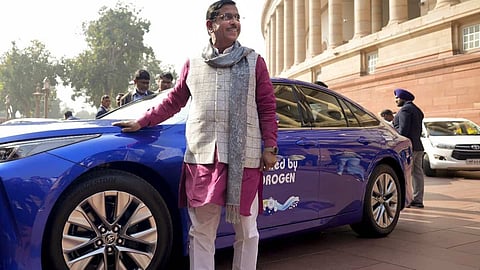

New Delhi: Pralhad Joshi, the Minister for New and Renewable Energy, hailed the introduction of hydrogen fuel cell electric vehicles as a transformative step in shaping India’s clean future on Thursday. Joshi drove a Toyota-manufactured hydrogen fuel cell electric car, Mirai, to the new Parliament building to showcase advanced hydrogen mobility.
Follow Energy Watch on X
“Drove the Toyota Mirai, powered by Hydrogen, to the Parliament today. MoS Shri @shripadynaik ji was also present. The ride was incredibly smooth, silent and comfortable, and with zero emissions, this vehicle demonstrates the transformative potential of hydrogen mobility in shaping India's clean future,” Joshi said in a post on X.
After the event, the minister noted that the new Parliament building, designed as a green building, is a fitting venue for showcasing advanced hydrogen mobility.
Earlier in the day, Joshi launched the Pilot project for field trials on the use of hydrogen in the mobility sector, describing it as “a major milestone in India’s clean energy advancements.” The initiative is being carried out under a memorandum of understanding signed between the National Institute of Solar Energy (NISE) and Toyota.
Addressing the MoU exchange ceremony, the minister said: “With the Mirai now being tested on Indian roads, the NISE–Toyota Kirloskar Motor partnership gives fresh momentum to our National Green Hydrogen Mission and supports real-world assessment of hydrogen fuel cell technology in Indian conditions. Such collaborations advance innovative low-emission mobility, strengthen Energy Aatma Nirbharta, and align with India’s Panchamrit climate goals. The government remains confident that green hydrogen will drive India’s energy economy in the years ahead.”
He underlined that green hydrogen is emerging globally as the backbone of future energy systems, adding that the collaboration “brings innovation, industry expertise and scientific rigour to advance India’s clean energy transition.” He said such partnerships strengthen “Energy Aatma Nirbharta”, promote innovative low-emission transportation solutions and reaffirm the government’s confidence that green hydrogen will drive India’s energy economy in the coming decades.
Calling the introduction of Toyota’s Mirai fuel cell electric vehicle “a new chapter for sustainable mobility,” Joshi reiterated that the name Mirai, meaning “Future” in Japanese, symbolises India’s aspiration for a clean, green and sustainable mobility ecosystem.
Under the MoU, NISE will conduct an extensive two-year real-world assessment of the Mirai in India’s diverse road and climatic conditions, including heat, dust, traffic congestion and varied terrain. The ministry said the testing will generate critical insights to scale up hydrogen mobility nationwide while building awareness and technical capability among industry, academia and policymakers.
Joshi highlighted that hydrogen fuel cell vehicles are clean, silent and emission-free, emitting only water, and that fuel cell technologies are increasingly powering cars, buses, trucks, trains, ships and stationary power systems worldwide.
The minister said that by personally driving the hydrogen vehicle, he wished to send a clear message that “hydrogen mobility is ready and well-suited for Indian conditions.” He added, “With this vehicle, we are launching not just an MoU but confidence, cooperation and commitment to a clean and sustainable future.”
Minister of State for New & Renewable Energy Shripad Yesso Naik said real-world testing of fuel cell electric vehicle technology such as the Toyota Mirai demonstrates India’s rapid movement “from policy to experimentation and further towards commercialisation of hydrogen-based mobility solutions.”
He said the initiative marks a significant step towards India’s clean, green and self-reliant energy future, noting that under Prime Minister Narendra Modi’s leadership, India has made unprecedented progress in energy transition, including the launch of the National Green Hydrogen Mission in January 2023.
Naik commended the partnership between industry, research institutions and government in advancing hydrogen technologies, emphasising that NISE’s assessment of the Mirai will generate valuable insights for future scale-up. He expressed confidence that the pilot project will support wider adoption of hydrogen-based transportation, improved air quality and sustainable development.
Vikram Gulati, Country Head and Executive Vice President, Corporate Affairs and Governance, Toyota Kirloskar Motor, said: “This partnership with the National Institute of Solar Energy (NISE) and the handover of the ‘Toyota Mirai’ for testing & Trails, reaffirm our dedication to supporting India's Green Hydrogen Mission and accelerating the nation's transition toward future mobility that is powered by green & indigenous energy sources. We believe hydrogen fuel-cell technology, alongside other sustainable public technologies, will play a pivotal role in helping India achieve its net-zero commitments and energy independence objectives.”
MNRE Secretary Santosh Kumar Sarangi, NISE Director General Dr Mohammad Rihan and National Green Hydrogen Mission Director Abhay Bakre also attended the event.
Follow Energy Watch on LinkedIN
The Toyota Mirai, a second-generation hydrogen fuel-cell electric vehicle, produces electricity through a chemical reaction between hydrogen and oxygen, emitting only water vapour. With a driving range of about 650 km and a refuelling time of under five minutes, it is among the world’s most advanced zero-emission vehicles.

