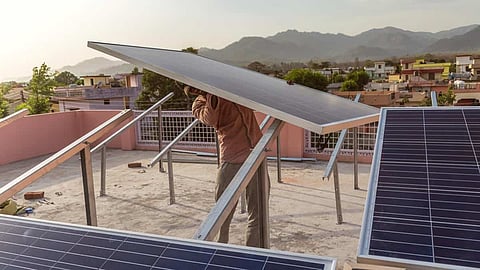

New Delhi: Adding a 5 kWh battery to a typical 3 kW household rooftop solar system in India would stretch the system’s payback period to about 9 years, from 3.3 years for solar alone. That is the finding of an analysis released on Thursday by Ruchita Shah, Energy Analyst, Asia at global energy think tank Ember. The battery would cut the household’s daytime electricity exports to the grid by 85 to 90 percent, the report said. Under the current net metering regime, however, the household would gain nothing financially from it.
Follow Energy Watch on X
Ember proposed that the next tranche of the PM Surya Ghar: Muft Bijli Yojana cover part of the battery cost. A 50 percent subsidy on battery capital costs would bring the payback for a solar-plus-battery system down to 6.3 years, according to the analysis. If hybrid systems were subsidised for even half of the scheme’s current target of 10 million households, India could build 15 to 25 gigawatt-hours (GWh) of distributed storage. The report put the financial support needed at around Rs 280 billion (Rs 28,000 crore).
“India’s rooftop solar boom is an opportunity to get ahead of the grid challenge, rather than wait for it to arrive. With more than 5 million households already adopting rooftop solar under PM Surya Ghar, we should be building storage alongside that capacity, not years later,” Shah said.
Under India’s net metering framework, a unit of solar power exported at noon is credited one-to-one against a unit consumed in the evening. Households, the report said, use less electricity during solar hours and more after sunset. They export their surplus at midday and draw it back after dark, so the grid acts as a “nearly free virtual battery” for them.
The value of those two units differs sharply, according to Ember. In the day-ahead market, prices fell to around Rs 1.56 a unit during high-solar hours in July 2026. In the evening, they rose about six-fold to the Rs 10 a unit cap. Electricity distribution companies (DISCOMs), therefore, credit cheap daytime exports against evening power they may have to buy at a far higher price, the report said.
Because households can bank unlimited surplus solar and withdraw it at any time, they have no financial reason to add a battery. To show this, Ember modelled a 3 kW rooftop system for a household using 350 units a month. The system costs Rs 1,65,000. After the Rs 78,000 PM Surya Ghar subsidy, that comes down to Rs 87,000, and it pays back in 3.3 years.
Adding a 5 kWh battery raises the overall capital cost to Rs 2,27,000, according to the report. It shifts around 1,600 to 1,800 units a year from the day to the evening. “The grid gains, the consumer does not,” Ember said in its statement, arguing that this builds a case for a financial incentive to households.
“The experience of markets like Australia and the US shows that as rooftop solar scales, its value increasingly depends on when its electricity is used, not just how much it generates. India can learn that lesson early, making batteries a win for consumers and the grid,” Shah said. The report cited California as an example. There, a shift from net metering to a net billing mechanism was paired with targeted storage incentives, which increased residential solar-plus-storage adoption.
India’s installed solar capacity reached 164.6 GW in July 2026, of which 30.7 GW was on rooftops, according to Ember. Rooftop solar’s share of total solar capacity has risen to about 19 percent from around 6 percent in FY2019. Residential rooftop capacity under PM Surya Ghar stood at 14.9 GW across 5 million households, almost half of the country’s rooftop total.
The PM Surya Ghar scheme, launched in 2024, aims to install rooftop solar on 10 million homes. It gives households a capital subsidy of Rs 30,000 per kW for the first 2 kW and Rs 18,000 per kW for additional capacity up to 3 kW. The subsidy is capped at Rs 78,000 per system.
Rooftop solar remains concentrated in a few states, the report said. More than 85 percent of capacity is installed in ten states, and Gujarat and Maharashtra alone account for close to 45 percent of the total, with 7,518 MW and 5,975.8 MW respectively.
In some states, rooftop capacity is now large relative to peak demand. As of July 2026, rooftop solar in Kerala equalled 35 percent of the state’s peak demand recorded between April and July. The share was 26 percent in Gujarat and 18 percent in Maharashtra, against 11 percent nationally. Kerala’s 2.3 GW of rooftop solar compares with an evening peak of 6.48 GW. Because that peak falls outside solar hours, the capacity lowers daytime net demand but does nothing to serve the evening peak, the report said.
Ember also pointed to the effect of net metering on DISCOM revenue. Households are billed only on net consumption, and residential tariffs rise with use. As a result, the units taken off a household’s bill are the most expensive ones at the top of the tariff slab, the report said.
In Maharashtra, a household consuming 450 units a month pays energy and wheeling charges of Rs 16.64 a unit for its last 150 units, according to the analysis. If it installs a 3 kW system generating about 350 units a month, its billed consumption falls to around 100 units. It then pays Rs 5.56 a unit, the rate for the 1-100 unit slab. In states such as Delhi, Punjab and Karnataka, the report said, net metering can move households into free or subsidised slabs without any cut in their actual consumption.
According to Ember, net metering benefits higher-consumption households the most. The resulting revenue loss to DISCOMs is partly borne by consumers without rooftop solar, many of whom are lower-income households unable to install it, the report said.
The analysis also modelled two possible future changes to net metering. The first is a 40 percent cap on banked exports, with residual exports compensated at Rs 2 a unit. Under that cap, a solar-plus-battery system would pay back in 9.4 years without a subsidy. The payback would fall to 6.5 years with a 50 percent battery subsidy and to around 8 years with a 25 percent subsidy.
The second scenario bars households from withdrawing banked solar between 6 pm and 10 pm and applies a 20 percent surcharge on the base tariff during those hours. A hybrid system would then pay back in 8.3 years without a subsidy, 5.7 years with a 50 percent battery subsidy and around 7 years with a 25 percent subsidy, Ember said. Home batteries would also let consumers take part in future demand response programmes, the report said.
Kerala and Maharashtra have begun exploring rooftop solar-battery hybrid systems, according to the report. Uttar Pradesh has issued a tender to install hybrid rooftop systems on government buildings. In early 2025, the Central Electricity Authority (CEA) suggested that DISCOMs could mandate two hours of storage alongside rooftop solar. The CEA has also proposed a separate tariff category for net metering consumers, with differentiated fixed, variable and time-of-day charges, the report said.
Follow Energy Watch on LinkedIN
Ember suggested that the battery incentive could be structured around eligible battery capacity or a defined share of storage cost, with technical and performance conditions attached. States could follow Tamil Nadu and Bihar in topping up the central subsidy, it said, but should direct that top-up at the battery cost gap rather than at solar alone. According to the analysis, a targeted subsidy would address the upfront cost barrier so that metering and regulatory changes can be made without stalling the rooftop boom.

