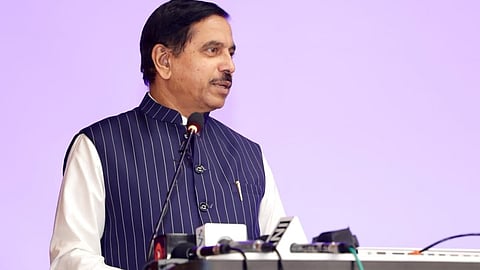


New Delhi: India's floating solar potential has been assessed at 102.18 GWp, according to a report released by Union Minister for New and Renewable Energy Pralhad Joshi on Wednesday, with the ministry working on a dedicated scheme to promote floating solar deployment across the country.
Follow Energy Watch on X
The report, prepared by the National Institute of Solar Energy (NISE) under the Ministry of New and Renewable Energy (MNRE), takes India's total assessed solar potential to 3,445 GWp, combining the floating estimate with the ground-mounted potential assessed last year. "India's energy transition is no longer confined to deserts and solar parks. Where we saw limitations once, we now see possibilities," Joshi said at the launch event.
"India's total assessed solar potential is 3,445 GWp, out of which 3,343 GWp is ground-mounted, and 102.18 GWp is floating solar potential," he said.
Joshi said that reservoirs and other water bodies are emerging as important assets for clean energy generation through floating solar projects. An MNRE statement added that the initiatives "reflect the Government's commitment to harnessing natural resources in a sustainable and efficient manner while accelerating India's clean energy transition."
MNRE Secretary Santosh Kumar Sarangi said the ministry is preparing support schemes for floating solar and agri-photovoltaics, and is in discussions with the Finance Ministry on them.
"We achieved the highest-ever solar installations last year of nearly 44 GW and this is only the beginning. Going by Niti Aayog's projection, we have to have nearly 1,600 GW of solar installation by 2050. As all of you know, we have the goal of becoming 'Viksit Bharat' by 2047. And that would require us to multiply and exponentially increase our renewable energy installation. In this context, it is imperative for us to look at ways in which solar deployment can increase," Sarangi said.
"So, apart from the deserts and barren lands of Rajasthan and Gujarat, we have to look at potential of increasing solar deployment elsewhere. And in this direction, two critical elements — floating solar and agri-photovoltaics, where farming can happen along with photovoltaic installation — are going to play a critical role in the next couple of years. These are two areas our ministry is going to focus in a big way in the future," he said.
"We have been in the process of preparing schemes which will support floating solar, which will support agri-photovoltaics. We are in discussion with Finance Ministry to come up with similar schemes which will have a catalytic effect in promoting solar and agri-photovoltaics in different states," the secretary added.
The NISE assessment found a potential of 102.18 GWp "derived from a feasible reservoir area of 1,946.24 km2, which represents approximately 18.15 percent of the total identified reservoir (10,725.99 sq. km)", in line with the report's constraint that no more than 20 percent of a state's reservoir area be utilised for solar deployment.
"Maharashtra (16.28 GWp) and Madhya Pradesh (14.89 GWp) emerge as the leading contributors, together accounting for nearly 31 percent of national potential, followed closely by Karnataka (13.69 GWp), Odisha (12.81 GWp), and Telangana (10.72 GWp)," the report said.
The state-wise rankings diverge from India's established ground-mounted solar geography. Odisha, at 12.81 GWp, and Telangana, at 10.72 GWp, rank ahead of Gujarat (6.32 GWp), Rajasthan (3.36 GWp) and Tamil Nadu (3.34 GWp) — states that have traditionally led India's solar capacity addition.
The distribution follows reservoir availability rather than solar irradiance. Southern and eastern states "benefit from a high density of medium-to-large reservoirs associated with irrigation and hydropower projects," the report said, while the leading states reflect "the density and scale of multipurpose irrigation and hydropower reservoirs across western, central, southern, and eastern India."
The assessment used a six-parameter geospatial methodology — waterbody characteristics, year-round water availability of at least 11 months, depths of 3 to 30 metres, solar irradiance above 4.5 kWh/m²/day, and proximity of 10 km to roads and substations. "Smaller and shallow water bodies have been deliberately excluded to avoid overestimation and to align the results with practical deployment considerations," the report said.
The report's scope covers inland and nearshore installations only, excluding offshore floating solar.
The report's energy yield simulations across 29 states found that the cooling effect of water bodies offsets the losses from the low fixed-tilt configurations used in floating plants. In a like-for-like comparison of fixed-tilt systems, "the maximum improvement of +6.74 percent was recorded," the report said, "confirming that thermal regulation through evaporative cooling is a key driver of enhanced generation efficiency in floating PV systems."
"In several states, especially those with warmer climates, FSPV systems achieved improvements ranging from approximately 2 percent to over 6 percent, with peak gains exceeding 8 percent in favourable conditions," the report said, while noting that "colder or high-altitude regions show limited or even negative gains."
The report said floating solar "contributes to water conservation by shading water bodies, thereby reducing evaporation by 30–60 percent", with large-scale projects demonstrating savings of "nearly 19.5 million cubic meters of water per year." It also flagged that floating systems are "currently approximately 25 percent more expensive upfront than land-based solar due to floating structures, anchoring, and waterproofing."
Joshi also launched an online portal for the Small Hydro Power Development Scheme, which the MNRE statement described as "the first major policy intervention in the small hydro sector since 2017", saying it will enhance transparency and efficiency in implementation.
NISE and the Military Engineering Services exchanged an MoU to strengthen the adoption of solar energy across defence establishments, under which NISE will provide technical support for planning, implementation and monitoring of renewable energy projects.
Follow Energy Watch on LinkedIN
Joshi said India's non-fossil fuel capacity has increased from 81 GW in 2014 to 288 GW, with solar capacity rising from 2.8 GW to 155 GW, while domestic module manufacturing capacity has reached 192 GW and cell manufacturing capacity 30 GW. He said India has transformed from a power-deficit nation into a power-surplus nation while emerging as a major renewable energy manufacturing hub.
Joshi also released the book "Green Energy and Sustainable Development", authored by NISE Director-General Mohammad Rihan.
