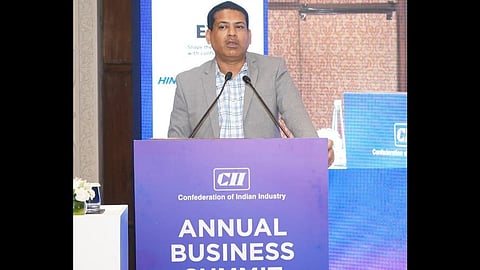

New Delhi: India is preparing a dedicated support scheme for polysilicon manufacturing, with the government looking to build at least 30 GW of capacity by 2030. Santosh Kumar Sarangi, Secretary at the Union Ministry of New and Renewable Energy (MNRE), set out the plan on Friday, on the sidelines of the Bloomberg New Energy Finance (BNEF) Summit. Polysilicon is the upstream feedstock of the solar manufacturing chain, and the segment India has so far not built.
Follow Energy Watch on X
Asked what capacity the country would need by 2030, Sarangi framed the target around supply risk. "To ensure India's energy security and ensure that India's manufacturing resilience is maintained, any capacity of 30 gigawatts and above should be good for the Indian context. So, we would look at at least 30 gigawatts of capacity addition by 2030," he said.
Sarangi put the capital requirement at about Rs 850 crore for each gigawatt of polysilicon capacity, taken together with metallurgical-grade silicon. On that basis, the 30 GW target carries an investment requirement of roughly Rs 25,000 crore.
A production-linked incentive scheme already covers the chain, Sarangi said, spanning polysilicon, wafers, cells and modules. The polysilicon leg of it is not delivering. Only a very small quantum of polysilicon capacity is likely to come up under that route, he said.
That gap is what the new scheme is meant to close. Sarangi said India needs a far larger base than the PLI will produce, and that the ministry is working on a scheme built specifically around polysilicon manufacturing. He did not share details of its structure or size.
Sarangi also turned to vanadium redox flow batteries (VRFB), a stationary-storage technology positioned as an alternative to lithium-ion. He expects prices to come down as demand builds, and pointed to research activity in the field and to an order already placed. "In the vanadium flow batteries, again I mentioned that NTPC Green Energy Limited has placed an order for 100 megawatts, and there are domestic manufacturers who are working and ensuring supply of that capacity," Sarangi said.
VRFBs are more durable than lithium-ion cells and better suited to large stationary installations.
The contract Sarangi referred to was awarded in July by NTPC Renewable Energy Limited (NTPC REL), a subsidiary of NTPC Green Energy Limited.
Bondada Engineering won the engineering, procurement and construction contract for a vanadium redox flow battery system at the Khavda Solar Park in Gujarat, with Delectrik Systems as technology partner. The completion timeline is 10 months from the award notification, with operations and maintenance running 10 years.
Follow Energy Watch on LinkedIN
Its rating is 100 megawatt-hours rather than 100 megawatts. It has been described as India's first and largest grid-scale project of the type.

