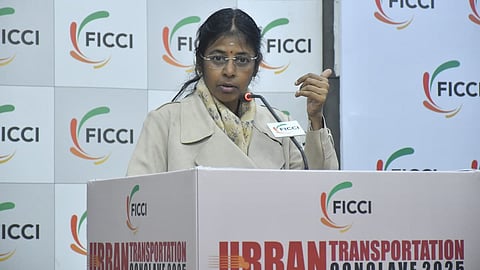

New Delhi: Speaking at the FICCI Urban Transportation Conclave on Tuesday, D Thara, Additional Secretary at the Union Ministry of Housing and Urban Affairs, told that whilst India has excelled at building large-scale systems like metro networks, it has failed to address the 35 percent of urban trips below five kilometres and the 30 percent of Indians who walk one to two kilometres daily to reach their livelihoods.
Follow Energy Watch on X
“Can we have solar-cooled pathways for people to walk four to five kilometres?” Thara said, announcing the ministry's willingness to support pilot projects. “We would like to support that pilot.”
The idea comes as India grapples with severe urban transport inequities. Thara highlighted that whilst only about 25-30 percent of the population owns cars, they consume 80 percent of road space, creating what she termed a fundamental question of “equity in road space”.
“You cannot regulate private transport without first providing very good public transport. You cannot do both without doing the first one,” she said, alluding to novel pricing mechanisms, such as “prefix cost” to regulate the number of vehicles entering cities and “suffix cost” through zone-based congestion charges.
On occasion, Shalabh Goel, Managing Director of National Capital Region Transport Corporation, reported progress on indigenous manufacturing, with 80 percent of metro and Regional Rapid Transit System components now made in India. The Delhi-Meerut RRTS corridor, operational at 160 kilometres per hour with world-class technology, exemplifies this advancement. However, Goel stressed the urgent need to eliminate the remaining 20 percent import dependency and address critical skill shortages in core engineering disciplines.
Industry leaders at the conclave painted a stark picture of India's public transport decline. Vivek Lohia, Co-Chairman of FICCI's Transport Infrastructure Committee and Managing Director of Jupiter Wagons, noted that public transport's share in urban commutes has plummeted from nearly 60 percent in 1994 to less than 35 percent in major metro cities today, whilst private vehicle ownership surged 300 percent over two decades.
Thara called for a comprehensive redefinition of mobility infrastructure, insisting that walking and cycling must be recognised as legitimate “trips” in transportation planning. “Trips are to be defined as when people move from one place to another. That's the first definition which should be changed,” she said, arguing that current planning focuses exclusively on organised motorised systems whilst ignoring pedestrian and cyclist movement.
She emphasised that multimodal integration must prioritise human movement, with pedestrians receiving priority access at stations whilst private vehicles take “a little longer route”.
Jagan Shah, former Director of the National Institute of Urban Affairs, emphasised that multimodal connectivity remains essential for transport optimisation. “It is not enough to build a Metro rail line. It is important to connect that Metro rail line and its stations with people's homes and offices,” he said.
Follow Energy Watch on LinkedIN
The ministry official also identified untapped infrastructure opportunities, calling for comprehensive mapping of defunct and underutilised suburban rail lines to develop semi-greenfield cities. “We should map all of them. There is quite a bit of infrastructure and we should integrate them and promote new cities on that,” she said, citing the Regional Rapid Transit System as a successful model where mobility has become a “real estate determiner.”

