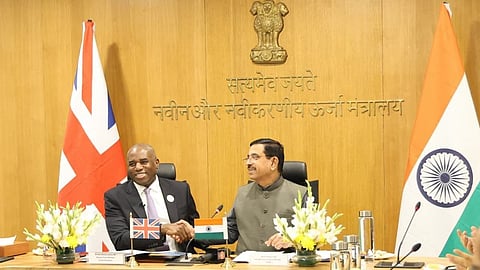

New Delhi: Union Minister for New and Renewable Energy Pralhad Joshi on Wednesday addressed the launch of the India–UK Offshore Wind Taskforce, in the presence of the Deputy Prime Minister of the United Kingdom (UK), David Lammy, and the British High Commissioner to India, Lindy Cameron.
Follow Energy Watch on X
Calling the initiative a “Trustforce,” Joshi said it reflects the confidence that India and the United Kingdom can work together to address “real execution challenges.” He urged that the platform deliver “time-bound workstreams, measurable milestones and visible progress,” converting global lessons into solutions tailored to Indian conditions.
In a post on X following the launch, Joshi said, “This Taskforce is truly a Trustforce, built on confidence, credibility and time bound execution.”
Describing it as a working mechanism rather than a symbolic platform, the Minister said the taskforce has been constituted under Vision 2035 and the Fourth Energy Dialogue to provide strategic leadership and coordination for India’s offshore wind ecosystem.
Joshi outlined three practical pillars for cooperation. The first relates to ecosystem planning and market design, including refined seabed leasing frameworks and credible revenue-certainty mechanisms. The second focuses on infrastructure and supply chains, including port modernisation, local manufacturing and specialised vessels. The third pillar centres on financing and risk mitigation through blended finance structures and mobilisation of long-term institutional capital.
He emphasised that the next phase of India’s energy transition must strengthen reliability, grid stability, industrial depth and energy security, adding that offshore wind has a strategic role in this journey.
Promising offshore wind zones have been identified off the coasts of Gujarat and Tamil Nadu. Grid planning, studies and surveys for initial projects have been conducted through the National Institute of Wind Energy.
To support early-stage projects, the government has introduced a Viability Gap Funding (VGF) scheme with a total outlay of Rs 7,453 crore, approximately £710 million.
Joshi noted that offshore wind is “among the most complex segments of the global energy transition,” requiring specialised port infrastructure, marine logistics, robust seabed leasing frameworks, clear risk allocation and bankable commercial structures.
Highlighting the linkage with India’s green hydrogen ambitions, Joshi noted that India is leading the Hydrogen Breakthrough Goal under the international Breakthrough Agenda and has achieved globally competitive benchmarks under the National Green Hydrogen Mission, with green hydrogen prices falling to a historic low of Rs 279 per kg (approximately £2.65 per kg) and green ammonia prices reaching Rs 49.75 per kg (approximately £0.47 per kg). The minister said offshore wind can provide high-quality renewable power to emerging coastal industrial and green hydrogen clusters.
In his post, he said, “We reaffirmed our commitment under Vision 2035 to deepen cooperation in offshore wind, green hydrogen and resilient clean energy supply chains.”
“With the UK’s experience and India’s scale, this Trustforce will deliver measurable outcomes for energy security and sustainable growth,” he added.
He also noted that the UK Deputy Prime Minister “appreciated India’s transformative progress” and lauded “India’s emergence as a global leader in #RenewableEnergy.”
Underlining that India’s clean energy transition is defined by execution at scale, the Minister said India has achieved over 50 percent installed power capacity from non-fossil sources ahead of target and is scaling solar and wind at a record pace.
India’s installed non-fossil fuel capacity has crossed 272 GW, including more than 141 GW of solar and 55 GW of wind capacity. In the ongoing financial year alone, India has added over 35 GW of solar and 4.61 GW of wind capacity.
Follow Energy Watch on LinkedIN
“With clarity of purpose and shared commitment,” Joshi concluded, offshore wind can emerge as a strong pillar of India’s “clean, reliable and self-reliant energy future,” and a flagship of India–UK cooperation under Vision 2035.

