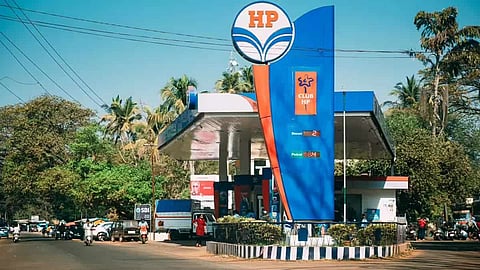


New Delhi: State-run oil marketing company Hindustan Petroleum Corporation Limited (HPCL) reported its strongest annual profit in years on Wednesday, with standalone profit after tax (PAT) surging 133 percent year-on-year to Rs 17,175 crore for the financial year ended March 31, 2026, against Rs 7,365 crore in FY25. On a consolidated basis, PAT nearly tripled to Rs 18,047 crore in FY2025-26 from Rs 6,736 crore in FY2024-25. However, some fault lines emerged — a worsening LPG liability, a fire at the flagship new refinery in Rajasthan and structurally rising depreciation and finance costs.
Follow Energy Watch on X
The primary engine of FY26’s outperformance was a sharp recovery in gross refining margins. HPCL’s average GRM for the year came in at USD 8.79 per barrel, up from USD 5.74 per barrel in FY25, a 53 percent improvement that reflects a combination of a better crude mix, higher distillate yields, and more favourable product cracks in global markets. The company processed 52 different grades of crude during the year, including four new grades introduced in the fourth quarter alone. Both its refineries ran above nameplate capacity for the full year: Mumbai Refinery at 105 percent utilisation with a record throughput of 10.00 million metric tonnes, and Visakh Refinery at 107 percent with a record 16.04 MMT. Combined, the two refineries delivered the company’s highest-ever annual crude throughput of 26.04 MMT, a 3 percent increase over FY25’s 25.27 MMT. Distillate yield hit a record 75.8 percent.
Revenue from operations grew a more modest 2.6 percent to Rs 4,78,543 crore, reflecting the broadly stable petroleum product prices in the domestic market. The PAT expansion is therefore driven almost entirely by margin improvement, not volume growth, an important distinction for investors assessing the durability of these earnings.
One revenue item that deserves specific attention: Rs 3,300 crore of HPCL’s FY26 topline represents LPG compensation from the government, recognised from a Rs 7,920 crore package announced by the Ministry of Petroleum in October 2025. The package is being disbursed in 12 equal monthly instalments starting November 2025, meaning only five instalments fell in FY26. The remaining Rs 4,620 crore is a deferred tailwind into FY27 — already earned, essentially, and waiting to be booked. This provides some earnings visibility.
The cumulative unrecognised negative LPG buffer, the gap between what HPCL charges consumers for domestic LPG cylinders and its actual cost of supply, stood at Rs 12,799 crore as of March 31, 2026, up from Rs 10,895 crore a year earlier. This is money the company has effectively subsidised but has no government authorisation to recover. It is carried off the books. The Rs 7,920-crore compensation package addresses prior-year losses only partially; the current-year losses continue to accumulate and expand against the backdrop of the West Asia crisis.
The fourth quarter (January–March 2026) was HPCL’s best quarter of the year. Standalone PAT for Q4 FY26 came in at Rs 4,902 crore, up 46 percent year-on-year from Rs 3,355 crore in Q4 FY25, and up 20 percent sequentially from Q3 FY26’s Rs 4,072 crore. The Q4 GRM was particularly striking at USD 14.27 per barrel, more than double Q4 FY25’s USD 8.44 per barrel. Consolidated Q4 PAT was even stronger at Rs 6,065 crore, up 78 percent year-on-year, boosted by a large swing in the company’s share of joint venture profits, which jumped to Rs 1,290 crore in Q4 from just Rs 121 crore in Q3 FY26.
However, finance costs jumped 43 percent sequentially from Q3 to Q4, from Rs 674 crore to Rs 965 crore. Depreciation rose 48 percent sequentially, from Rs 1,619 crore to Rs 2,400 crore — a near-record for a single quarter. Both trends reflect the capitalisation of large assets and will structurally pressure net margins in FY27, more so as oil marketing companies continue to incur under-recoveries on fuel sales.
Total income for Q4 was marginally lower sequentially — Rs 1,24,538 crore versus Rs 1,25,169 crore in Q3 — despite the much stronger profitability, confirming that the profit expansion came entirely from margin improvement and cost structure, not revenue growth. Domestic sales in Q4 were 12.43 MMT, slightly down from Q3’s 12.68 MMT, though up 2.6 percent year-on-year.
Total standalone debt fell from Rs 63,323 crore as of March 2025 to Rs 47,599 crore as of March 2026 — a reduction of over Rs 15,000 crore in a single year. The debt-equity ratio improved sharply from 1.38x to 0.80x on a standalone basis, and from 1.30x to 0.78x on a consolidated basis. This was made possible by operating cash flows of Rs 36,107 crore in FY26, more than double FY25’s Rs 14,276 crore.
The reduction in short-term borrowings is particularly notable — from Rs 31,656 crore to Rs 15,353 crore on a standalone basis — suggesting the company has actively paid down working capital debt using its profit windfall. Net worth rose to Rs 59,847 crore from Rs 45,958 crore.
Long-term borrowings actually increased marginally, from Rs 31,667 crore to Rs 32,246 crore, indicating that while short-term debt was paid down, the company continued to take on long-term capital for its investment programme. Total consolidated assets grew to Rs 2,03,039 crore from Rs 1,94,745 crore.
The HPCL Rajasthan Refinery Limited project — a 9 MMTPA greenfield refinery and petrochemical complex at Pachpadra, Rajasthan, being built at a cost of Rs 79,459 crore with HPCL holding a 74 percent stake — is central to the company’s next growth chapter. An investor presentation flags it as a route to a 2x+ jump in EBITDA by FY28 and a step-up in refining capacity from 35.8 MMTPA to 45.3 MMTPA.
Construction is 91.6 percent complete as of March 31, 2026. Trial runs commenced, with 176 TMT of crude processed in February 2026. But on April 20 this year — after the financial year closed — a fire broke out in the crude distillation unit (CDU) of the refinery. Any delay to HRRL’s full commercial operations pushes back the earnings contribution from this massive capital outlay.
The board has recommended a final dividend of Rs 19.25 per equity share of face value Rs 10, subject to shareholder approval at the annual general meeting. The record date is set for August 14, 2026. This is in addition to the interim dividend of Rs 5 per share already paid during FY26, taking total FY26 dividends to Rs 24.25 per share. The total dividend payout represents a significant increase over prior years and reflects management’s confidence that the balance sheet can support shareholder returns alongside the ongoing capex programme.
Other expenses for FY26 include Rs 2,491 crore in losses from foreign currency transactions and translation, compared to just Rs 450 crore in FY25. That is a nearly six-fold increase, and it is a direct drag on operating costs. As a large importer of crude oil and a company with significant foreign currency borrowings, HPCL carries meaningful forex exposure. The FY26 figure suggests that rupee depreciation and hedging costs took a significant toll, and will remain a variable to watch in FY27.
Follow Energy Watch on LinkedIN
HPCL’s strong FY26 numbers were, to a significant degree, a product of a favourable GRM environment. That environment is already shifting. Oil marketing companies, including HPCL, have continued to hold petrol and diesel retail prices steady even as global crude prices have been volatile — buffeted by supply chain disruptions caused by the West Asia war and the blockade of Strait of Hormuz. Analysts and investors will also be closely watching for any update on HRRL’s commissioning timeline and whether the April fire caused any structural damage to the CDU beyond what HPCL’s initial assessment suggests.
