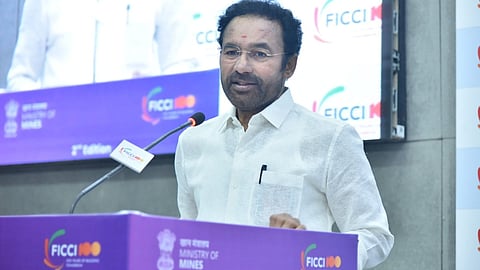

New Delhi: The government has identified Andhra Pradesh, Odisha, Maharashtra and Gujarat to host critical-minerals processing units, a move the Ministry of Mines says will push India from raw extraction toward midstream value addition. Minister for Mines G Kishan Reddy made the statement while addressing FICCI’s summit on the country’s critical minerals landscape on Thursday.
Follow Energy Watch on X
“Four states - Andhra Pradesh, Odisha, Maharashtra and Gujarat, have been identified for establishing Critical Minerals Processing Units to boost domestic value addition and reduce import dependence,” Reddy said.
The announcement takes on added significance because processing of critical minerals is heavily concentrated in China. International energy and supply-chain analyses show China handles the lion’s share of midstream refining for rare earths, battery chemicals and permanent-magnet production — a structural bottleneck for countries hoping to secure independent supply chains. Estimates put China’s share of rare-earth refining and magnet production at the vast majority of global capacity, and it accounts for a dominant share of lithium and other battery-chemical refining.
Those global figures help explain why establishing processing hubs domestically is central to policy: even where mines exist outside China, ores are often shipped to Chinese refineries for separation and metal-making. Analysts say the result is a persistent vulnerability for downstream industries such as EVs, defence and renewables.
Reddy said production of permanent magnets — a key downstream product for electric vehicles and wind turbines — will begin “by the end of this year” under a production-linked incentive (PLI) scheme of Rs 7,280 crore.
He also reiterated broader policy measures aimed at encouraging investment and lowering input costs, saying the government was “exempting import duty on importing of raw materials for critical minerals” and had created a separate fund to support the sector. The minister said support would also flow through instruments such as the National Mineral Exploration Trust.
Reddy urged a shift from resource dependency to value creation, noting India is “95 percent dependent on imports of critical minerals.” “Over 4,000 critical mineral exploration activities have already been initiated across the country,” the minister added. He said nine Centres of Excellence have been identified to strengthen R&D and skills in the sector.
The statement also named 143 coal mines for mine-closure activities to be completed by 2028, framing the processing push as part of a wider resource-optimisation and transition strategy.
International partners and industry groups at the summit welcomed the drive to build processing capacity. Ed Jager, Minister (Commercial) at the High Commission of Canada in India, said: “Critical minerals are now strategic assets shaping the global economy. Canada intends to be a stable and responsible partner for India as we deepen cooperation across exploration, processing and resilient supply chains.” Industry executives described the reforms as a mission-level opportunity to build domestic value chains.
Follow Energy Watch on LinkedIN
Policy watchers say the four-state processing plan is a more tangible, execution-oriented development than headline-level mission outlays. Building midstream processing — from separation and refining to magnet and cathode manufacture — is the hardest and most capital-intensive part of the chain, and it is where global capacity today is most concentrated in China. If India succeeds in establishing commercially viable processing hubs, it would mark a meaningful step toward reducing import vulnerability for critical inputs used across clean-energy and defence sectors.

