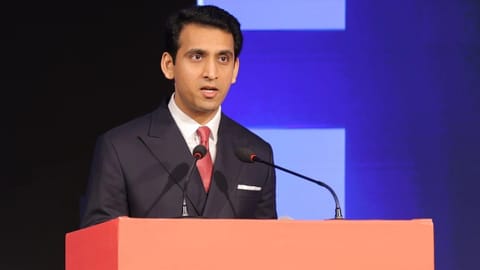

New Delhi: Sagar Adani, executive director of Adani Group entity Adani Green Energy Ltd, on Wednesday urged India to build stronger domestic infrastructure to protect energy security and remain steady through global shocks, including wars and geopolitical disruptions.
Follow Energy Watch on X
Speaking at a session of the Resilient Futures Summit organised by Economist Enterprise, he said the old question of how fast a country can grow is being overtaken by a more urgent one: how well it can absorb disruption.
"We've all seen how conflict in one region can disrupt supply chains across continents. We've all seen how shocks in energy markets can ripple through economies overnight," he said, noting that the question for every nation is no longer just how fast can you grow, it is: How well can you withstand disruption."
Adani said energy is not a standalone sector but the base layer for several other national priorities. He said water security depends on energy for desalination, treatment and distribution. Food security, he said, needs energy for fertilisers, irrigation, and logistics. Digital leadership also depends on it, because data centers, AI, and computing infrastructure all require large amounts of power. Economic stability, he added, rests on keeping that power affordable for ordinary citizens.
"So, if India is to become a developed economy by 2047, we are not talking about incremental growth. We are talking about a structural leap. We are talking about adding nearly 2,000 gigawatts of new capacity over the next two decades," he said.
He said most wealthy and developed countries are either energy independent or have built deep strategic energy partnerships that reduce their vulnerability.
Drawing a contrast with China, Adani said that even though the country remains constrained in oil and gas, it has steadily invested in domestic capacity across coal, hydro, nuclear, and renewables, while also building strategic reserves and supply chains.
For India, he said, the route ahead is clear. "We must electrify everything. We must reduce structural dependence on imported energy. And we must build an energy backbone anchored in resources that are available within the country."
He said India should adopt a multi-pronged energy strategy because that is the only way to keep decarbonisation aligned with energy security. "Renewables will, and must, scale rapidly. Storage technologies will continue to evolve. But there are real constraints -- particularly around land and intermittency," he said, adding that India, therefore, needs a "portfolio approach."
"We must fully leverage every energy source available to us: Renewables. Hydro. Efficient thermal and nuclear. Because without firm, scalable baseload power, the math simply does not work. This is not optional for India. It is inevitable," he said.
Adani also praised policy changes over the past decade, saying India’s leadership has played an exceptional role in cutting red tape, removing outdated regulations, revitalising public undertakings and encouraging private enterprise.
"We see ourselves not just as operators of infrastructure, but as builders of India's energy backbone for the next several decades," he said, while referring to Adani Group's USD 100 billion commitment towards the energy transition.
He said the group’s work across ports, logistics, airports, and data centers follows the same logic, since resilience cannot be created in separate compartments.
Follow Energy Watch on LinkedIN
"Because in the end, resilience is not built through intent alone. It is built through execution. Through the ability to create infrastructure at scale, at speed, and with purpose." He ended by linking India’s domestic buildout to a wider global role.
"We will not just secure our own future. We will not just elevate 1.4 billion people... We will help stabilise the future of the global economy. Because India does not operate in isolation."

