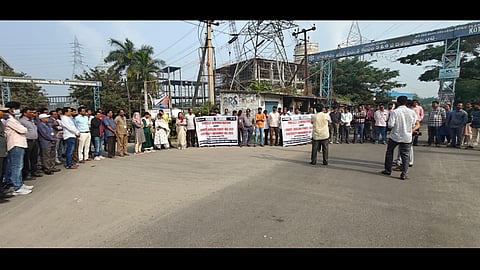

New Delhi: Power employees and engineers, central trade unions and farmers’ organisations held coordinated protests across the country on Tuesday against the Sustainable Harnessing and Advancement of Nuclear Energy for Transforming India (SHANTI) Act, 2025, the Electricity (Amendment) Bill 2025, and the ongoing privatisation of electricity distribution in Uttar Pradesh.
Follow Energy Watch on X
Shailendra Dubey, chairman of the All India Power Engineers Federation (AIPEF), said the National Coordination Committee of Electricity Employees and Engineers, the platform of central trade unions and the Samyukt Kisan Morcha have described the proposed nuclear legislation as a threat to nuclear safety and accountability, and have demanded its withdrawal.
According to Dubey, the SHANTI Act dismantles India’s existing framework of nuclear safety and accountability and opens the sector to large-scale private and foreign participation. He said the erstwhile Atomic Energy Act ensured strict public control over civilian nuclear activities because of their strategic and destructive risks, while the proposed bill replaces this with a profit-oriented licensing system that allows private operators to enter critical segments of the nuclear value chain.
The unions argue that this marks a decisive shift towards privatisation of nuclear operations while transferring the risks to the public. By repealing the Civil Liability for Nuclear Damage (CLND) Act, they said, the bill removes the operator’s statutory right of recourse against reactor suppliers, allowing manufacturers to escape liability for faulty equipment or design. As a result, they warned, the financial burden of nuclear accidents would fall on victims and the government rather than profit-making companies.
On the Electricity (Amendment) Bill 2025, Dubey said the proposed law allows private entities to earn revenues by using government-owned power networks while ending subsidies, a move he said would hit common consumers and farmers the hardest.
He said the provision that electricity cannot be supplied below cost would push the minimum tariff to around Rs 10–12 per unit, making power unaffordable for farmers and poor consumers. He added that the National Coordination Committee of Electricity Employees and Engineers, central trade unions and farmers’ organisations have decided to launch a nationwide mass movement against electricity privatisation and the proposed amendment.
The NCCOEEE, the central trade union platform and the Samyukt Kisan Morcha said power employees, farmers and unions have come together against electricity privatisation, the draft Electricity (Amendment) Bill 2025 and the privatisation drive in Uttar Pradesh, which they alleged is being pursued through repression and harassment. They said a broad nationwide campaign against privatisation will be carried out over the coming year.
Follow Energy Watch on LinkedIN
Large protests were reported on Tuesday from Hyderabad, Jammu, Srinagar, Patiala, Hisar, Nagpur, Thiruvananthapuram, Dehradun, Kolkata, Ranchi, Raipur, Jabalpur and Rajkot. The organisations said that, to mark the birth anniversary of former prime minister Chaudhary Charan Singh, protests will be held across all districts of Uttar Pradesh on December 24.

