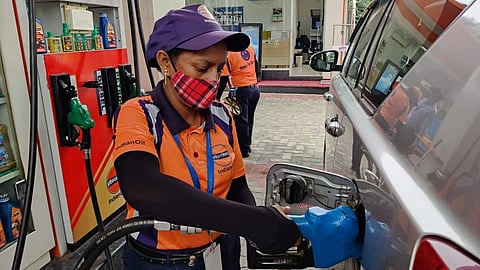


New Delhi: The Centre has banned industrial, commercial and institutional diesel buyers from purchasing fuel at public petrol pumps, invoking the Essential Commodities Act, 1955 to stop bulk consumers from arbitraging a price gap created by the government's own policy of shielding retail consumers from the impact of the West Asia conflict.
Follow Energy Watch on X
The Motor Spirit and High Speed Diesel (Temporary Regulation of Supply through Retail Outlets) Order, 2026, notified in an extraordinary Gazette on June 11, caps diesel sales at retail outlets at 200 litres per customer or vehicle per day and explicitly bars institutional and bulk buyers from the retail channel altogether. It comes into force immediately and is initially valid for 90 days.
"Institutional and Direct or Industrial and Commercial customers shall not procure or cause to be procured MS and/or HSD from Retail Outlets and shall only source their MS/HSD requirements from their own consumer pumps," the notification states.
The order is a direct consequence of a price distortion the Centre itself introduced. To protect household consumers from the ongoing West Asia supply disruption, PSU oil marketing companies — Indian Oil, Bharat Petroleum Corporation Ltd (BPCL) and Hindustan Petroleum Corporation Ltd (HPCL) — are currently selling petrol, diesel and domestic LPG below cost, absorbing losses of around Rs 500 crore per day. That margin loss has opened a Rs 40-per-litre chasm between retail pump prices and market-linked bulk diesel rates, a gap wide enough that factories, fleet operators and commercial establishments began abandoning their designated consumer pumps and queuing up at retail outlets instead.
"Abnormal increases in sales of Motor Spirit and High Speed Diesel through Retail Outlets in certain parts of the country are driven by shifting of industrial, commercial and institutional consumers to Retail Outlets owing to the price difference between retail and bulk sale prices," the gazette notification said, warning that this was "resulting in diversion of supplies intended for retail consumers and creating the potential for localised shortages and disruption of essential services to common man."
Ministry data for May 2026 puts numbers to that trend: diesel sales through PSU retail outlets surged in 327 districts by more than 10 percent compared to the same month last year, with 80 of those districts recording growth exceeding 30 percent. Over the same period, private oil marketing companies saw their high-speed diesel sales collapse by around 58 percent as consumers, bulk and retail alike, migrated to the cheaper PSU pumps.
The ministry said the problem had gone beyond simple arbitrage. "Blatant instances of procurement of large quantities of diesel in jerry cans, and its resale have come to the notice of government," it said, adding that the order would "enable strict action against such buyers/operators, dealers and officers who are involved in this black marketing and hoarding of diesel."
The gazette extends search and seizure powers to gazetted officers of the Central and state governments, police officers of the rank of Deputy Superintendent of Police and above, and oil company officers not below the rank of sales officer. State governments and Union Territory administrations have been directed to take action against hoarding, black marketing and unauthorised diversion under the Essential Commodities Act and related orders.
Violations are punishable under the Essential Commodities Act, 1955.
The 200-litre daily cap on retail diesel purchases technically applies to all customers at a pump, including private vehicle owners. However, the ministry was emphatic that the restriction is not aimed at them. "For the average person driving a car or riding a two-wheeler, the 200-litre cap is far beyond what any private vehicle would need," it said. Retail outlets will dispense diesel only into vehicle fuel tanks or containers approved by the Petroleum and Explosives Safety Organisation (PESO); the HSD so purchased cannot be resold.
The ministry sought to dispel any suggestion of a supply crisis: "This is not a rationing measure, and there is no shortage of petrol or diesel in the country. Notably, India remains the world's 4th largest refiner and 5th largest exporter of refined petroleum products."
Follow Energy Watch on LinkedIN
The order is framed explicitly as temporary, valid for 90 days from the date of notification unless revoked earlier. The gazette, however, leaves the door open for extension: "If the order is not revoked prior to its expiry, then for it to remain in force beyond the initial period, it shall have to be extended by another order." The government may also exempt specific consumers, areas or categories of transactions by special order.
