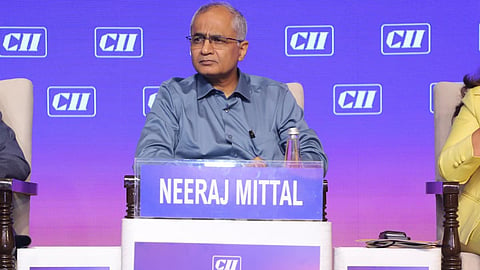


New Delhi: The government is not planning any fuel rationing despite prolonged disruptions in global energy markets and shipping routes, Oil Secretary Neeraj Mittal said on Monday, seeking to reassure consumers over fuel availability as geopolitical tensions continue to unsettle oil markets.
Follow Energy Watch on X
Addressing CII’s Annual Business Summit in New Delhi, Mittal said India had maintained comfortable inventory levels through the recent disruption period and had taken multiple steps to secure supplies.
“There is no need to panic. There are sufficient supplies. There is no rationing in place. It's not going to happen,” he said.
According to him, India has continued to hold around 60 days of fuel stocks and nearly 45 days of LPG inventories during the past 67 days, even as conflict-related disruptions affected energy shipments and trade flows.
The clarification comes amid heightened concerns over rising global crude prices following the conflict in West Asia and speculation around possible domestic fuel price increases. Prime Minister Narendra Modi on Sunday had appealed for fuel conservation, lower imports and restraint in discretionary overseas spending, including foreign travel and gold purchases.
Retail petrol and diesel prices have remained unchanged for nearly two years even though global input costs have surged since the West Asia conflict intensified around 10 weeks ago.
Industry estimates suggest state-run oil marketing companies are currently absorbing losses of Rs 1,000 crore to Rs 1,200 crore as crude-linked costs have climbed by more than 50 percent without a corresponding rise in pump prices.
A senior government official said the administration’s priority remained maintaining supply stability and shielding consumers from volatility. “The default mode of the government is to keep the prices and supplies stable,” the source said.
Mittal said India had responded to the evolving situation by diversifying crude procurement and increasing purchases from both new and existing suppliers. “We have procured from other sources. We have procured from other countries. We have increased procurement from existing countries and that has kept us going in terms of supply management in the short run,” he said.
He acknowledged that supply constraints linked to the geopolitical situation had not eased. “The constraint has not changed at all. In fact, it is a shade worse,” he said.
Despite the challenges, Mittal said India had managed to safely move 14 ships through the Strait of Hormuz during the disruption period.
Demand controls and digital tracking helped manage LPG supplies
The oil secretary said India’s refining capacity had helped cushion domestic markets from external shocks, enabling uninterrupted local supplies while allowing exports of refined products to continue.
He also outlined measures adopted to manage LPG distribution during the disruption period. Household cooking demand was prioritised, while industrial LPG supply restrictions were later relaxed to 70 percent following requests from industry.
Mittal said digitised tracking of LPG cylinder deliveries had helped curb diversion and black-market activity, with monitoring now covering almost the entire distribution network.
Mittal said the government was examining alternative approaches to expand India’s strategic petroleum reserves without tying up excessive capital. “For a country like India which consumes 5 million barrels a day, to have a 90-day reserve would be putting a lot of money in a box without using it at all,” he said.
India currently consumes around 5 million barrels of oil daily, making it the world’s third-largest crude importer and consumer.
Mittal said the government was exploring commercial structures that could allow strategic reserves to generate returns while remaining available for emergency use.
Alongside supply management, the government was also accelerating efforts to boost domestic production and expand alternative fuels, Mittal said. These initiatives include green hydrogen, ethanol blending and sustainable aviation fuel.
Follow Energy Watch on LinkedIN
He added that the Centre had used fiscal tools, including excise duty cuts on petrol and diesel, to absorb part of the global price shock, resulting in a revenue impact of around Rs 1.6 lakh crore.
“Government uses all sorts of tools,” he said, adding that India had remained “a relative oasis of calm” compared with countries that had imposed fuel rationing or stricter demand curbs.
