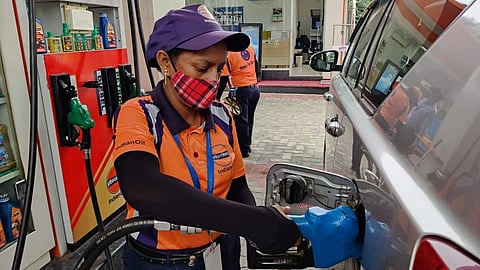


New Delhi: State-owned Oil Marketing Companies (OMCs) raised petrol and diesel prices by Rs 3.04 per litre, respectively, effective Friday, ending a four-year freeze on retail fuel prices. The price revision of more than three percent comes amid surging global crude oil costs driven by the US-Israeli war on Iran and supply chain disruptions because of a blockade in Strait of Hormuz.
Follow Energy Watch on X
According to price build-up data from Hindustan Petroleum Corporation Limited (HPCL), petrol at the company's retail outlets in Delhi now costs Rs 97.81 per litre, with the base price to dealers at Rs 77.51, dealer commission at Rs 4.41, and VAT at Rs 15.89. Diesel, meanwhile, retails at Rs 90.71 per litre, with the base dealer price at Rs 74.42, dealer commission at Rs 3.03 and VAT at Rs 13.26. Earlier, petrol cost Rs 94.77 per litre, while diesel cost Rs 87.67 per litre.
Despite the revision, the three OMC stocks fell sharply on Friday. Indian Oil shares opened at Rs 140.69 but tanked to Rs 136.12 around 1 pm. HPCL shares opened at Rs 366.75 but dropped to a low of Rs 363.65 around 11.40 am. BPCL shares opened at Rs 293.55 before dropping to Rs 284.20.
Investors had anticipated higher hikes, as the three oil marketing companies are incurring losses pegged at around Rs 1,000 crore daily because of holding fuel prices steady against the volatility in the global crude oil market. Analysts said the hike fell well short of what the companies needed. Nomura had estimated a Rs 15–20 per litre increase is needed for OMCs to stop incurring losses.
OMC stocks were trading near their all-time highs around end-February, but following the escalation of the West Asia conflict, their prices have corrected nearly 25–30 percent from their peaks. Analysts fear that the price hike was much lesser in quantum than what was expected and do not rule out further hikes in case the Strait of Hormuz does not open for business.
State-owned Indian Oil Corporation (IOC), Bharat Petroleum Corporation Ltd (BPCL) and HPCL had abandoned daily price revision in April 2022 to insulate domestic consumers from steep increases following Russia's invasion of Ukraine. They incurred heavy losses in the first half of the 2022–23 fiscal year, which they recouped when rates fell in subsequent months. The war in West Asia has replicated that crisis at a larger scale.
The basket of crude oil that India imports averaged USD 69 per barrel in February before the war in West Asia broke out. It averaged USD 113–114 per barrel in subsequent months. On Friday, Brent rose to USD 106.89 per barrel, up 1.11 percent from the previous day, and is up over 63 percent compared to the same time last year. WTI crude was trading between USD 101.49 and USD 102.92 on Friday.
The IEA has warned that the global oil market could stay materially undersupplied through October even if the conflict is resolved next month, while Saudi Arabia has informed OPEC that its output has dropped to its lowest level since 1990.
Arvind Kumar, Director (Refineries), IOCL, sought to reassure consumers on supply. "It is a very small rise. There is a lot of pressure. But I can tell you that Indian Oil group companies and refineries are working round the clock at more than 100 percent capacity, so that there will be no crisis and no dryout at any of our retail outlets," he said.
Prashant Vasisht, Senior Vice President and Co-Group Head, Corporate Ratings, ICRA Ltd, said the revision provides only marginal relief. "The modest hike in retail price of Rs 3/litre for petrol and diesel provides limited relief to the oil marketing companies. ICRA estimates that at crude price of USD 105–110 per barrel and considering past 10-year average crack spreads of auto fuels, oil marketing companies incur a loss of about Rs 500 crore daily on the sale of auto fuels and domestic LPG, even after factoring the fuel price hike. Accordingly, the oil marketing companies would need to relook at the retail prices in case elevated crude oil prices persist," he said.
Follow Energy Watch on LinkedIN
The combined under-recovery on petrol, diesel and cooking gas LPG is Rs 1,000–1,200 crore daily, according to industry sources.
Antique Stock Broking, in a note on May 12, said government officials had flagged that every 10 percent increase in crude oil prices, if passed through to consumers, leads to 50 basis points higher inflation and 15 basis points lower growth — a constraint that limits how aggressively the government can allow prices to be raised.
