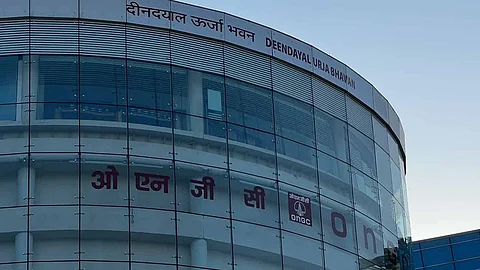


Quitol (Goa): State-run Oil and Natural Gas Corporation (ONGC) plans to move its exploration activity beyond existing assets and drill up to 100 exploratory wells a year in remote and deepwater areas, ramping up ultra-deepwater activity and raising capital expenditure to pursue higher-risk, higher-reward finds to reverse the decline in crude oil output in recent years, Director (Exploration) Om Prakash Sinha said.
Follow Energy Watch on X
“We are going to take more risk and we expect that more rewards should come,” Sinha said, underlining a strategic shift away from incremental drilling near existing infrastructure towards frontier and deepwater prospects.
ONGC’s standalone crude oil production has been on a downward trend since the middle of the last decade. Output fell from 21.1 Million Metric Tonnes (MMT) in 2015–16 to 18.1 MMT in 2023–24, before a marginal uptick to 18.56 MMT in 2024–25.
The decline reflects natural depletion in mature fields and limited additions from new discoveries, increasing pressure on the company to pursue larger, higher-risk exploration targets.
Sinha said ONGC is scaling up activity in deep and ultra-deepwater areas, where individual wells are expensive but offer the potential for large discoveries. “In recent years, we have been drilling three-four deep and ultra-deep wells in a year. We will be increasing it to eight or 10 wells,” he said while speaking to the media on the sidelines of India Energy Week (IEW) 2026, adding that the pace would depend on survey results.
“CAPEX for drilling deep and ultra-deep wells will be around Rs 9,000-10,000 crore for FY26 and around Rs 13,000 crore for FY27,” he said.
ONGC has traditionally focused on exploratory drilling close to existing producing assets to sustain output, a strategy that is now being recalibrated. “Earlier, we were drilling more exploratory wells near the existing infrastructure,” Sinha said. “Now we are going remote, we are going in deep waters, we are going in frontier areas where we expect that we will hit big finds.”
While the overall number of exploratory wells will remain at around 100 a year, the share of capital-intensive deepwater and frontier wells is set to rise sharply.
Sinha said ONGC’s deepwater exploration drive will largely focus on the east coast, where multiple basins remain underexplored at depth. “The Indian east coast will mostly be the focus areas,” he said, citing the Krishna-Godavari, Mahanadi, Cauvery and Andaman basins. He added that ONGC has also stepped up activity in deepwater areas off the west coast beyond Mumbai High, including offshore Kerala.
In November 2025, ONGC has established the presence of a thermogenic natural gas system in one of the three wells drilled in the Andaman basin, said the Director (Exploration). “That is a big discovery. We have established presence of thermogenic gas in one of the three wells in November. Only thing remaining is we have to find sizeable volumes. Those kind of volumes which are viable on a commercial scale from remote basins like Andaman. That is yet to come,” he said.
“So, thermogenic gases are those gases which can be found in big sizes, big volumes to sustain commercial viability,” said Sinha.
Alongside higher-risk drilling, ONGC is also pursuing collaboration through resource and infrastructure sharing, beginning with a recently signed agreement with Reliance Industries in the KG basin.
The agreement allows both operators to share surplus resources on a cost basis. “It is not sharing free-of-cost,” Sinha said. “Whatever resources one company has surplus, if it is required by the other company, it can be shared,” he said.
He said infrastructure sharing would be increasingly critical, particularly in offshore and deepwater areas where duplicating facilities is often uneconomic. “If the infrastructure is shared, it’s a win-win situation. Nobody is required to put the entire investment for creating the facilities,” he said.
Such sharing could help monetise small offshore discoveries that have remained idle. “Those small fields were lying earlier idle. By using existing facilities, they will come up for production,” Sinha said, adding that this approach would extend beyond the KG basin and involve more operators over time.
Separately, Sinha said ONGC is also pursuing exploration partnerships through joint bidding, stating that the company is planning to bid alongside ExxonMobil in OALP Round X. “When we venture into deepwater areas, it is extensively cost-intensive,” he said. “The idea is to share the financial risk, share the expertise and reduce the timelines.”
Follow Energy Watch on LinkedIN
Joint bids would allow ONGC to induct advanced technologies, distribute capital risk and accelerate the transition from exploration to production, he said. “Ultimately, the objective is that the blocks come for exploration and production in a faster way.”
