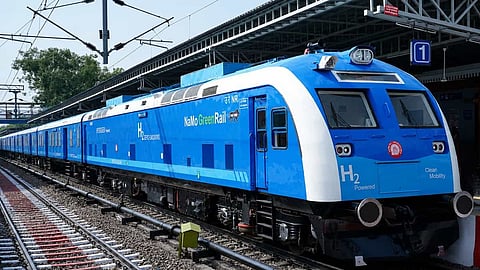

New Delhi: India has stepped into a small club of nations running passenger trains on hydrogen. Prime Minister Narendra Modi has flagged off the country's first Hydrogen Fuel Cell Trainset on Friday, a train that generates its own electricity onboard using hydrogen and produces near-zero emissions at the point of use. For the Railways that has spent the last decade racing to electrify, this is the next frontier.
Follow Energy Watch on X
The moment is also daubed with history. In a sense, the train once again carries its own source of power, just as steam and diesel locomotives once did, but instead of burning coal or diesel, it uses hydrogen and oxygen from the atmosphere to generate electricity onboard, eliminating combustion and the need for an external power supply, especially useful for routes in remote areas and difficult terrains that are still awaiting electrification.
Here's what all that you need to know about India's first Hydrogen train:
Forget combustion. There is no burning of fuel here. A hydrogen train carries a small power plant onboard in the form of a Proton Exchange Membrane (PEM) fuel cell. Hydrogen stored in the train's cylinders combines with oxygen from the surrounding air inside the fuel cell, producing electricity that powers the traction motors and turns the wheels.
The by-products? The only direct outputs of this electrochemical reaction are water vapour and heat. There is no combustion, no smoke and no tailpipe carbon emissions.
As the Ministry of Railways puts it, the equation is almost deceptively simple: Hydrogen + Oxygen → Electricity + Water Vapour → The Train Moves
Structurally, the train consists of two Hydrogen Driving Power Cars (DPCs) and eight Trailer Coaches, and each power car houses fuel cells, lithium iron phosphate (LFP) batteries and hydrogen storage cylinders. The two power cars, one at each end, produce 1,200 kW (1,600 hp) each, together enough to push the train up to 110 km/h.
The train will initially operate on the Jind–Sonipat section of Northern Railway, connecting Jind Junction, Gohana Junction and Sonipat, along with several intermediate stations and halts. It runs at an operational speed of 75 kmph on this section, with a design speed of 110 kmph, across the 89-km route, taking around two hours to cover the distance. Railways picked this stretch specifically to demonstrate the operational viability, safety and reliability of hydrogen-powered passenger services under regular operating conditions.
However, the next chapter is expected to be scenic. Indian Railways is exploring the deployment of hydrogen technology on heritage railways, including the Kalka–Shimla route, drawing on the experience gained from the Jind–Sonipat project.
The scale is the story. Most hydrogen passenger trains operating globally comprise only two or three coaches and run on short regional routes. India's trainset has been configured as a 10-coach passenger train with a capacity of around 2,600 passengers. Germany was the first country to introduce commercial hydrogen passenger trains, with France, Italy, China, Japan and others pursuing pilots, but those trains typically run two-to-four coaches for regional services. India, in other words, is betting on hydrogen at high-capacity scale.
The strategic logic ties back to fuel security and decarbonisation. Over the past 12 years, rapid electrification has significantly reduced Railways' dependence on imported diesel, and with over 99 percent of Broad Gauge routes now electrified, hydrogen is the next leap in clean rail mobility. These initiatives, the ministry says, mark a transition from a pioneering pilot to a structured national programme for hydrogen-powered rolling stock, contributing to the National Green Hydrogen Mission and the country's long-term Net Zero goal.
This is not imported technology. Designed, engineered and integrated in India, the train uses indigenous technology, developed under the leadership of Indian Railways, with the Research Designs and Standards Organisation (RDSO) formulating the technical specifications and leading design approval. The trainset was integrated by M/s Medha Servo Drives, while the Integral Coach Factory (ICF) contributed the train's theme and exterior design.
This is where the ecosystem comes in. Indian Railways has established India's largest railway hydrogen refuelling facility at Jind in Haryana, operating in three stages.
First, hydrogen is produced on site through electrolysis, splitting water into hydrogen and oxygen, using electricity at a green hydrogen plant. The fuel is then stored in dedicated tanks. Second, it is compressed to 500 bar so a larger quantity fits into a smaller volume. Finally, it is dispensed through two independent dispensers at a regulated 350 bar, allowing both power cars to refuel simultaneously and cutting turnaround time.
The facility stores nearly 3,000 kg of hydrogen at a time, enough to support regular operations, and its storage and supply system has been approved by the Petroleum and Explosives Safety Organisation (PESO), said the Railways.
Responding to the question, the Railways said: hydrogen needs real care. It is colourless, odourless, tasteless and non-toxic, but highly inflammable, so the entire safety design is built around detecting even the smallest leak instantly.
Rather than one safeguard, Railways has adopted the internationally accepted principle of "defence in depth," where multiple independent systems continuously monitor every stage of hydrogen storage, transfer and use. In practice, that means continuous detection of leaks, heat, flames and smoke; non-stop ventilation that dilutes any leaked hydrogen in the open air; and an automatic shut-off that can cut the hydrogen supply on its own without waiting for a human to react. The Loco Pilot's cabin has a special mode to move the train to safety in an emergency and a screen showing real-time system health.
Follow Energy Watch on LinkedIN
The Railways said that the safety sign-off wasn't in-house alone. The ecosystem was designed to international standards, including NFPA-2 and the ISO 19880 series, and underwent an independent third-party safety assessment by TÜV SÜD, Germany before commissioning. The train also cleared load box, radio frequency, oscillation and emergency brake distance trials before it was cleared to carry passengers.

