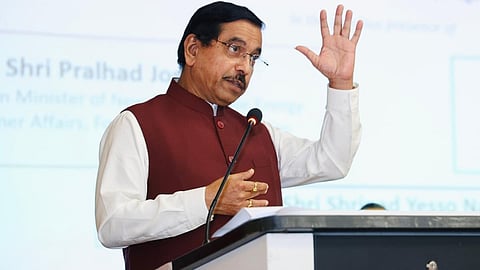


New Delhi: Union Minister of New and Renewable Energy Pralhad Joshi said on Monday that the exchange of Green Ammonia Purchase Agreements and Green Ammonia Supply Agreements marks “an important step in strengthening India’s energy security, especially at a time when the world is facing uncertainty.”
Follow Energy Watch on X
He said the 10-year agreements between industry, Solar Energy Corporation of India (SECI) and fertiliser companies provide demand certainty, enable financial closure and support large-scale investment in green ammonia production. Joshi also said the initiative could save about USD 2.5 billion in foreign exchange over 10 years through substitution of imported grey ammonia in non-urea based fertiliser units.
Joshi said that under the leadership of the Prime Minister Narendra Modi, India has demonstrated that economic growth and climate action can move together at scale and speed. He noted that India is today one of the fastest growing renewable energy markets in the world which has decoupled economic growth and sustainability and is on track to achieve 500 GW of non-fossil fuel capacity by 2030.
The minister emphasised that energy security is closely linked to national security and highlighted the importance of reducing import dependence in critical sectors. He stated that replacing imported grey ammonia with green ammonia will strengthen domestic capability and build resilient supply chains.
JP Nadda, Minister for Chemicals & Fertilisers, described the move as “a historic and forward-looking step towards building a robust green ammonia ecosystem in the country.” He said the agreements mark “the operationalisation of green ammonia in India” and reflect the government’s commitment to sustainable and affordable solutions in the fertiliser sector. Nadda said the initiative would reduce import dependence, improve affordability and strengthen self-reliance, adding that it will ensure “that farmers have nothing to worry about.” He also said that with the allocation of about 7.24 lakh tonnes per annum of green ammonia, India is moving decisively towards “Aatmanirbhar Bharat.”
According to a statement, the agreements cover IFFCO’s Kandla unit, which will receive 1,00,000 tonnes a year of green ammonia at Rs 54.73 a kg from ACME Cleantech, and its Paradeep unit, which will receive another 1,00,000 tonnes a year at Rs 49.75 a kg from the same developer. Coromandel International’s Kakinada unit is linked to 85,000 tonnes of green ammonia a year at Rs 50.75 a kg from Jakson Green and OCIOR, while its Visakhapatnam unit is linked to 50,000 tonnes a year at Rs 51.89 a kg from ACME Cleantech. Paradeep Phosphates’ Paradeep unit is tied to 75,000 tonnes a year of green ammonia at Rs 55.75 a kg from ACME Cleantech, its Zuarinagar unit to 25,000 tonnes a year at Rs 62.84 a kg from ACME Cleantech, and its Mangalore unit to 15,000 tonnes a year at Rs 57.65 a kg from SCC Infrastructure Pvt Ltd.
Ostwal Krishna Phoschem’s Meghnagar unit will get 70,000 tonnes of green ammonia a year at Rs 51.80 a kg from NTPC Renewable Energy. Madhya Bharat Agro Products’ Sagar unit will receive 60,000 tonnes a year of the green fuel at Rs 52.25 a kg from Oriana Power, while its Dhule unit is linked to 70,000 tonnes a year at Rs 53.05 a kg from SCC Infrastructure Ltd. Indorama India’s Haldia unit is linked to 20,000 tonnes of green ammonia a year at Rs 64.74 a kg from ACME Cleantech. SECI has allocated a total capacity of about 7,24,000 tonnes per annum to selected developers, with supply linked to 13 fertiliser units across the country.
The green ammonia supplied under these agreements will substitute 25 percent of grey ammonia used by these non-urea fertiliser units, said Abhay Bhakre, Mission Director, National Green Hydrogen Mission (NGHM), with the MNRE.
Follow Energy Watch on LinkedIN
The National Green Hydrogen Mission has an outlay of Rs 19,744 crore and targets at least 5 million metric tonnes of green hydrogen per annum by 2030. Under the SIGHT programme, SECI’s competitive bidding for green ammonia has yielded a record low discovered price of Rs 49.75 a kg and a range of Rs 49.75 to Rs 64.74 a kg. The release said international discovered prices have been reported at about Euro 1000 per tonne, or around Rs 110 a kg, indicating that Indian prices are competitive by global standards. The ministry said the next phase of India’s energy transition will focus on hard-to-abate sectors such as fertilisers, refineries, steel and transport, where green hydrogen and its derivatives are expected to play a major role.
